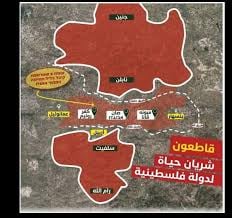
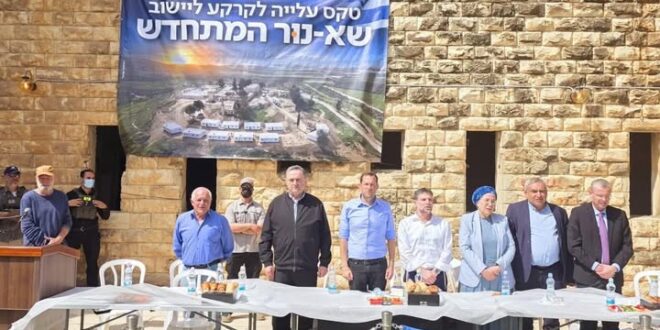
Last Sunday, Israeli Occupation Authorities revived the Sanur settlement during a ceremony attended by Yossi Dagan, head of the Samaria Regional Council – the umbrella body for settlements in the northern West Bank – along with several Israeli ministers and officials. Sanur was a settlement dismantled in Ariel Sharon’s 2005 disengagement plan from the Gaza Strip and northern West Bank. The settlement is located on land belonging to the Sanur town, south of Jenin.
The inauguration ceremony was attended by the Army Minister, Katz, FM Smotrich, and a large number of settler leaders and Israeli officials, who joined 16 families in what they termed their ‘return’ to their homes in the settlement. The ‘return’ was presented as a ‘historical correction’ to the disengagement plan, following a preliminary cabinet decision to approve settlement activity despite the lack of completed legal procedures.
As a reminder, Sanur is one of four isolated settlements, along with Homesh, Ganim, and Kadim, established in the 1980s. Following the Oslo Accords, these settlements became isolated enclaves in Area C, severing Palestinian contiguity in the region. When the area was evacuated in 2005, then PM Ariel Sharon explained that the move aimed to ‘reduce the intensity of daily friction and casualties on both sides’. This process began in March 2023 with the approval of an amendment to the ‘Unilateral Disengagement Law’, which was welcomed by many countries, particularly the USA at the time, and which lifted the ban on Israelis residing in the evacuated areas.
The Sanuz settlement is not an exception but a model, as next to it comes the Ganim settlement, which the occupation authorities are promoting to return to within a few months again in an unprecedented settlement expansion in the northern West Bank, as announced by Yossi Dagan last week. The head of the Council of Settlements in the northern occupied West Bank, Yossi Dagan, announced on Thursday the official start of procedures to re-establish the evacuated Ganim settlement, east of the city of Jenin.
Since the approval of the ‘historical correction’, the pace of settlers returning to the area has accelerated. In May 2023, a military order was issued to cancel the implementation of the disengagement in Homesh, and a year later, at the direction of the then Army Minister, Yoav Gallant, the cancellation was extended to include the entire area in the northern West Bank.
Bezalel Smotrich, who participated in the ceremony, described the settlers’ return to the area, saying: ‘We are erasing the shame of the expulsion and ending the idea of a Palestinian state. This step is a historical rectification of the criminal expulsion from northern Samaria.’ Both the FM and the Army Minister, who also participated in the ceremony, called for the occupation of Gaza, saying, ‘The Gaza Strip and the refugee camps in the center must be occupied, military rule established, and settlements built throughout the Strip.’
Katz, in his address called for Israel to expand its control in the West Bank and boasted that the government would soon legalize 140 settlement outposts. He described the move as another step to strengthen the settlements and weaken the Palestinians’ attempt to establish a presence in the area. Ze’ev Elkin, the minister responsible for the reconstruction of the north and south, expressed his desire to annex the West Bank to the State of Israel: ‘We all share another vision here, which is that these settlements will soon be within the sovereign territory of Israel, and this will also be achieved.’
Knesset Member Eti Havatia – Likud- head of the Foreign Workers Committee, saw the move as an opportunity to impose sovereignty quickly. Settlement and National Development Minister Orit Strock stated, We will continue on this path and return to all parts of our country. Rabbi of Samaria, Elyakim Libanon, affirmed ‘our eyes are also on the Gaza Strip’, followed by Rabbi Dov Lior, ‘With God’s help, we will soon be able to return to full Jewish settlement throughout northern Samaria, Gaza, and Gush Katif.’
Israeli officials competed in the provocative inauguration ceremony. Tourism, Construction, Housing, Welfare, and Health Minister Haim Katz declared, ‘I have been waiting for this moment for 21 years. In our revolution against the disengagement, we fought the evacuation decision, and even when we couldn’t change it at the time, we believed we would rectify the situation in the future.’
Knesset Member Ariel Kalman – Likud – stated, ‘No power in the world can sever the connection between the people of Israel and their land.’ Yossi Dagan, head of the Samaria Regional Council -the umbrella organization of settlements in the northern West Bank – announced, ‘We will soon return, God willing, to Ganim and Kadim, and we will build more new settlements.’
The occupation forces had imposed strict security measures around the area during the ‘families’ return to their homes’ ceremony, which included closing side roads and tightening restrictions on the movement of Palestinians in neighboring villages. This is in a scene that indicates the acceleration of settlement projects in the northern West Bank, where the occupation government is working to strengthen its presence in the areas classified as C, while reviving settlement outposts that were previously evacuated, as part of efforts to impose new facts on the ground that prevent Palestinians from establishing their state away from settlement and settler terrorism.
At the same time, settlers seized hundreds of dunams of land in the Taybeh village, east of Ramallah, and wreaked havoc and destruction in a wide number of towns and villages in the Ramallah Governorate, including burning houses, destroying vehicles, damaging fields, and uprooting many trees, especially olive trees, in the towns and villages of Ein Sinya, Turmusaya, Sinjil, Abu Falah, and Al-Mughayyir, and prevented citizens from accessing their lands.
The Taybeh village, like other villages in the West Bank, suffers beyond endurance. Its suffering continues unabated. While Christians around the world celebrated Easter, the Christians of Taybeh were engaged in a silent battle for survival. Settler attacks have transformed the town’s tranquility and familiar peace into a perilous silence, threatening the security of its inhabitants and the future of their historical presence.
Taybeh, one of the oldest Christian centers, has roots stretching back thousands of years. Perched on hills 900 meters above sea level, its natural beauty overlooks the Jordan Valley. This strategic location has been denied its benefits due to its encirclement by four settlements and numerous outposts that spread their poison against the land and its people.
The presence of these surrounding settlements has left the residents in a constant state of anticipation, especially with the repeated settler incursions and attacks on their land and property, between the fencing and the confiscation, this village has lost about 1,500 dunams since the Israeli aggression on the Gaza Strip in Oct. 2023, which the occupation has turned into a vital area for settlements, outposts, and so-called pastoral farms on its lands.
Not far from the Taybeh lies Al-Mughayyir – the village of martyrs – where settler violence and terrorism reached an unprecedented level after two Palestinians were killed and others wounded last Tuesday in an attack by settlers on the village. The two martyrs are: Aws Hamdi Naasan, a 9th grade student and the son of a martyr who was killed 5 years ago, and Jihad Marzouq Abu Naim, 32.
The settler government headed by Netanyahu and the Israeli army are trying to cover up this terrorism, but in vain. Israeli researcher Gideon Abital Epstein, known for his work documenting and criticizing occupation policies, especially regarding violence in the West Bank, wrote a few days ago in Haaretz newspaper, ‘The current government is responsible for the situation, as were previous governments. But between the political echelon and the military leadership stands Chief of Staff Eyal Zamir, who bears responsibility for what is happening in the West Bank.
He believes that the army, at best, ignores the violations, at worst, provides cover for them, and sometimes even participates in them.” Meanwhile, the young man, Awda Atef Awawdeh, 25, was martyred by settlers’ bullets in the town of Deir Dibwan, succumbing to injuries sustained from live ammunition during the settlers’ attack on the town.
On another level, and within the context of the ongoing land grab in the West Bank, settlement expansion continues in various forms. This expansion is no longer limited to the construction of thousands of housing units in settlements or to outposts and agricultural and pastoral settlements, but extends to industrial projects with both economic and political dimensions. The ‘Amirim’ industrial project, recently announced on land belonging to the town of Al-Dhahiriya, south of Hebron, stands out in this context.
This move is an extension of policies aimed at reshaping the geography and economy and linking it to the Israeli economy. On February 12th, Israeli Minister of Economy and Industry Nir Barkat stormed the area adjacent to the separation wall in the region and, accompanied by the head of the Hebron Regional Council, Eliram Azoulay, announced the establishment of an industrial zone covering approximately 2,400 dunams.
He stated that his ministry had invested around NIS 12 million shekels in planning the project, with plans to inject an additional NIS 35 million to begin implementation. This settlement project is not isolated from broader settlement plans in the region, including the establishment of the ‘Omer’ industrial town north of Beersheba, which was later separated from the West Bank after the construction of the apartheid wall.
In 1983, the occupying state established the ‘Teneh Omerim’ settlement on the lands of Al-Dhahiriya, before later expanding with the establishment of the ‘Metarim’ industrial zone, which includes waste treatment facilities, solar energy projects, and settlement administrative headquarters near the ‘Meitar’ crossing. This crossing was an economic lifeline for tens of thousands of Palestinian workers before they were barred from working inside Israel after Oct 2023. The proposed location of the project, near the Green Line, reflects an Israeli tendency to erase the borders between the West Bank and the territories occupied in 1948.
The Iindustrial zones established by the Israeli Occupation Authorities in the West Bank cover several governorates and serve as an economic pillar for the settlements. Among the most prominent of these zones are the ‘Bustan Hefetz’ and Barkan industrial zones, as well as industrial areas in the settlements of Ariel, Ma’ale Adumim, Modi’in Illit, and Beitar Illit. The zones are part of a broader effort to bolster the settlement presence. They combine the economic exploitation of Palestinian resources and labor with the consolidation of the settlement enterprise and the Judaization of the land. According to reports by the Israeli State Comptroller, there are 35 Israeli industrial zones in Area C of the West Bank. Six of these were established in the late 1970s and early 1980s, and have since expanded gradually due to the ongoing policy of land confiscation in Area C.
The occupation has found environment in this area, with its low-cost land, cheap labor, and legal framework and incentives unavailable within Israel. Before the brutal Israeli war on the Gaza Strip, 40,000 Palestinian workers were employed in West Bank settlements, including about 17,000 in these Israeli industrial zones. After 7 Oct. the total number of Palestinian workers dropped to around 25,000, while the number of workers in these industrial zones fell to about 14,500. The industrial zones have devastating environmental impacts on the surrounding Palestinian communities, particularly since many of the factories operating within them produce goods prohibited within Israel.
List of Israeli Occupation and Settlers’ Assaults over the
Last Week Documented by the National Bureau:
Jerusalem:
- Approving a plan last Monday to establish a Jewish school called Or Somya in the heart of Sheikh Jarrah, despite objections from human rights organizations. The project includes the construction of a massive 11-story building on 5 dunams of land at the southern entrance to the neighborhood, opposite the Sheikh Jarrah Mosque. It will include dormitories for hundreds of Haredi Jewish students, as well as housing units for faculty members.
- Forcing Sami Hashlamoun Ayoubi to demolish his home in the Sawana Neighborhood of Jerusalem, based on a municipal order claiming he built without a permit. They also forced Wael Hashem Jalajel to demolish his own home in the Bustan Neighborhood of Silwan, south of the Al-Aqsa Mosque. Moreover they forced Jalajel to demolish 2 apartments in the same neighborhood.
Hebron:
- Attacking farmers and activists in the Huwara area of Masafer Yatta, south of Hebron, prevented them from harvesting their crops and assaulting them.
- Assaulting Palestinians in Wadi Khneis, west of the Sa’ir town, northeast of Hebron, while they were working their land, attacked them and caused injuries to elderly woman Um Hussein Jabarin.
- Storming Khirbet Rakeez in Masafer Yatta, south of Hebron, and provoked residents in the area.
- Attacking Palestinian-owned land in Khirbet Raboud, near Dura, in southern Hebron. The attack included bulldozing agricultural land, part of ongoing attempts to seize land and displace its owners. Moreover, armed settlers from the settlement of Otniel, built on Palestinian land in Masafer Yatta, completely burned 2 vehicles belonging to brothers Khaled and Yasser Abu Ali after infiltrated their homes in the Majd al-Ba’ area west of Yatta.
- Attacking farmers in the Wadi al-Shinar area, in Halhul, north of Hebron injured several citizens. They also vandalized a fence surrounding Palestinian-owned farmland in the Huwwara area before stealing crops.
- Demolishing an inhabited house in the Sha’ab al-Bir area of Tarqumiya, west of Hebron. Moreover, in Khirbet Salama, southwest of Hebron, young man Moh’d Ahmad Abu Ghaliyeh was killed, Al-Suwaiti, 25 was shot by the occupation authorities with live ammunition, allegedly for trying to approach the Negohot settlement built on citizens’ lands in Masafer Yatta, south of Hebron.
- Killing Moh’d Majdi Al-Ja’bari, 16 as a result of being run over by a settler in Beit Einun, north of Hebron.
Bethlehem:
- Attacking Palestinian homes and uprooted newly planted olive saplings in the Ash Ghrab area of Beit Sahour, east of Bethlehem. They also attacked homes in the Jabal Harasa area, further east.
- Seizing the Rujm al-Naqa police station in the village of Rashayda, east of Bethlehem, and extended a water network to it.
- Demolishing fences in the Jamla area, in the village of Maniya, east of Bethlehem grazed their sheep on Palestinian-owned land, and damaged some trees.
- Storming the Solomon’s Pools area, located between the town of al-Khader and the village of Artas, south of Bethlehem, and positioned themselves between the 2nd and 3rd
- Conducting a provocative tour of the village of Khala’il al-Luz, southeast of Bethlehem, and positioned themselves in the Water Well area to provoke residents.
- Deciding to demolish the home of Bashar Adnan Salah after rejecting his appeal to halt the demolition, which had been previously submitted, on the pretext of lacking a building permit.
Ramallah:
- Seizing hundreds of dunams of land in the village of Taybeh, east of Ramallah. A landowner stated, settlers have erected a fence around 1,500 dunams of Palestinian-owned land in the village, preventing residents from accessing their land since the start of the war on Gaza.
- Setting fire to the home of Asaad Tuffaha and a vehicle belonging to Rateb Khatib in the town of Turmus Ayya, northeast of Ramallah. A Palestinian man was injured in a settler attack on the village of Ein Sinya, north of Ramallah, after a group of settlers pelted several homes with stones and assaulted residents.
- Attacking the home of Mustafa Zaatar and stormed the eastern part of the company and provoked residents. Settlers also erected a new settlement outpost in the Turmusayya plain, north of Ramallah, near Palestinian homes.
Nablus:
- Setting fire to a vehicle in the town of Asira al-Qibliya, south of Nablus, belonging to citizen Ahmed Hamdan Ahmed, which damaged its front end. They also attempted to burn a warehouse and equipment belonging to citizen Hassan Asayra.
- Bulldozing land on the summit of Mount Ebal, north of Nablus, as part of attempts to seize land and impose new realities in the area. Settlers stole four sheep from the Al-Tal’a area, east of the town of Beit Furik, east of Nablus.
- Storming the Wadi Hassan area in the town of Asira Shamaliya, north of Nablus, accompanied by their livestock, and roamed among citizens’ agricultural lands.
- Attacking a house in Khirbet al-Marajem, which belongs to the lands of the village of Duma, targeting the home of citizen Nayef Musa Muslim, and damaged his water meter. They also attacked employees of the Beita municipality while they were working on maintaining a water line in the Qamas area of the town.
- Bulldozing a water reservoir near Ain al-Dalba in the town of Burqa, northwest of Nablus, affected agricultural lands in the same area. Eight Palestinians, including an infant, were injured when settlers attempted to set them on fire inside their home following a violent settler attack on the town of Beit Imrin, northwest of Nablus.
- Bulldozing dozens of fruit trees in the plain of Lubban Sharqiya village, south of Nablus, for the second day in a row, specifically near the girls’ secondary school and the main entrance. They also bulldozed more than 10 dunams of agricultural land.
Jenin:
- Notifying several shop owners in the town of Jaba’, south of Jenin, that their shops, located on the main street in Jaba’, would be demolished. Among those notified was Omar al-Saman, whose shops were threatened with demolition under the pretext that they were close to the Tarsala settlement, which settlers officially returned to on Sunday.
- Storming the site of the evacuated Kedim settlement in Jenin, near the eastern neighborhood of Jenin.
Jordan Valley:
- Publishing maps and aerial photographs with the aim of confiscating areas of land in the Murashahat Neighborhood, north of the Aqabat Jabr camp, west of Jericho, with the aim of paving a new settlement road in the area.
- Attacking residents in the Wadi Abu al-Hayat community north of Jericho, they also stormed homes in the Arab Malihat area north of Jericho, chasing shepherds.
- Roaming among the homes of residents, threatening them during the raid in the Wadi Abu Hayat community west of al-Auja, north of Jericho. The community is home to displaced families from the Arab Ka’abneh tribe.
- Demolishing the Malih school in the northern Jordan Valley. The head of the Malih village council, Mahdi Daraghmeh, reported that settlers stormed the community and demolished the school and surrounding homes. He noted that the settlers’ ongoing attacks had previously forced Palestinian families to leave the area.
- Destroying water pipelines east of Tammun, south of Tubas, in the “Bir al-Ma’yar” area east of Tammun town.