المكتب الوطني للدفاع عن الارض ومقاومة الاستيطان منظمة التحرير الفلسطينية
مقالات مشابهة
Settlement Weekly Report 2 – 8 May, 2026
By: Madeeha Al-A’raj
The ‘National Bureau for Defending Land and Resisting Settlements stated in its latest weekly report , that last Monday, Finance and Settlement Affairs Minister Bezalel Smotrich, and Transportation Minister Miri Regev announced that the government has decided to allocate an additional NIS 1.075 billion for settlement roads, as supplementary funds from the Finance Ministry’s budget, for the years 2026 – 2028 in addition to the NIS 7 billion that already allocated for paving roads in West Bank settlements, noting that the new allocation represents about 30% of the budget for intercity roads in the Occupation State.
Definitely, in recent years the government has invested enormous sums in developing bypass roads in the West Bank to facilitate the construction of new settlements and the expansion of existing ones. In June 2024, Minister Smotrich announced, during an internal conference of the Religious Zionist Party, the allocation of NIS 7 billion for settlement roads over 5 years. This represents a staggering sum of NIS 1.4 billion annually.
For comparison, the total budget for intercity roads in the entire occupied territories over the past four years has been About NIS 4.5 billion annually – according to data on the implementation of the intercity road budget-. This means that roughly 30% of Israel’s intercity road budget has been allocated to settlements, which are home to only 3% of the Israeli population.
As for the new bypass roads mentioned in the joint statement by Smotrich and Regev can be classified as roads under construction: roads under construction/near the start of work, such as the Quarries Axis / Jaba Bypass Road, Ramallah, Qalandiya Tunnel, Al-Eizariya – Al-Za’im, Jerusalem Eastern Ring Road, Jerusalem Sha’ar Binyamin to the British Police Junction, Ramallah, Jerusalem to Bani Na’im, Bethlehem, Hotel Bypass Road, Qalqilia, Nurseries Road, Qalqilia, Ariel Junction – Tapuach, Nablus, Modi’in Illit – Shilat, Ramallah, Luban Bypass, Ramallah, Hizma – Adam, Ramallah, Sila al-Dahr Bypass, Jenin, Beitar Illit – Husan, Bethlehem; and roads in the preparation and planning stage, such as Dolev – Route 443, Ramallah – detailed planning for implementation, Modi’in Illit – Route 443, Ramallah – legal planning, Atarot Junction, Ramallah – detailed planning for implementation, Al-Issawiya Junction, Jerusalem – detailed planning for implementation, Beitar Illit – Givat, Bethlehem – planning Legal planning from the Nablus-Taffuh Junction – Legal planning from Bani Na’im to Shama’a al-Khalil – Legal planning Kfar Etzion – Jaba Bethlehem – in effect, Beit El – Route 60 Ramallah – Detailed implementation plan for the Jordan Valley Road – Legal planning
Since its formation at the end of 2022, this government has begun constructing numerous bypass roads to connect existing settlements in the West Bank without passing through Palestinian population centers, and to facilitate their direct connection to Israel. Examples include the Huwwara bypass ‘Za’tara Junction’, the al-Aroub bypass, the Qalandiya Tunnel, the al-Lubban al-Gharbiya bypass, the Nabi Elias bypass, the eastern ring road around Jerusalem, the widening of Route 60, which runs through the West Bank from north to south, and the Gush Etzion-Dead Sea road. It is worth noting that the occupying power has constructed over 952 km of bypass roads in recent years, which have significantly hampered the development of Palestinian communities in the West Bank.
In addition to the new bypass roads, which serve as a lever for the settlement project, the Higher Planning Council of the Israeli Civil Administration is considering plans to build 643 housing units in several West Bank settlements. The accelerated pace of planning discussions and rapid approvals reflects the Israeli government’s determination to resume settlement activity at an accelerated rate in the northern West Bank, including areas that have not seen a settlement presence for more than two decades. Adding the plan to build 517 housing units in the settlements of Masua and Mahane Gadi in the northern Jordan Valley, the total number of housing units approved by the council in 2026, including those currently under consideration, reaches 3,732, of which 1,338 are in the settlement of Kedumim, where Bezalel Smotrich resides.
The settlement outpost of Mahane Gadi was one of the outposts that the Israeli government legalized in July 2024, transforming it from an unauthorized, random outpost into an independent settlement. This legalization was part of a package of decisions that also included the outposts of Givat Hanan in Masafer Yatta and Kedem Arava in the northern Jordan Valley. The newspaper Yediot Aharonot also revealed that the occupation authorities intend to establish two new settlements in the Jordan Valley, Bezeq and Tamon, in implementation of a decision made by the Israeli government last December.
The decision to establish Bezeq and Tamon is part of a broader plan developed by the Settlement Council, which aims to create 18 new settlements in the area. The head of the Settlement Council in the northern West Bank, Likud member Yossi Dagan, indicated that the establishment of these settlements aims to strengthen control over the land and consolidate the settlement presence in the northern West Bank. Thus, 2026 marked a decisive turning point in the settlement movement.
Since the formation of the current government, more than 100 settlements, outposts, and pastoral farms have been approved in the West Bank. It is worth noting that, amidst the tensions with Iran, the cabinet, in a secret meeting, approved the establishment of an additional 34 settlements. Details of the meeting were kept strictly confidential for fear of international pressure that might hinder this move.
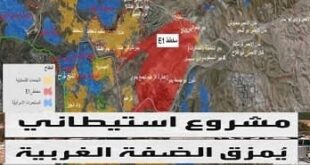
In light of escalating settlement activity and the Israeli government’s determination to proceed with its settlement plan in the E1 area, a number of European ministers, ambassadors, and officials addressed an open letter to EU leaders last Wednesday, demanding urgent action against what they described as Israel’s ‘illegal annexation” of the occupied West Bank through the E1 project, which aims to construct thousands of housing units.
The letter, signed by 448 former European officials, including former European Commission Vice-President Josep Borrell and former Belgian Prime Minister Guy Verhofstadt, stated that the EU and its member states, in cooperation with their partners, must take immediate steps to deter Israel from continuing its illegal annexation of Palestinian land in the West Bank.
The signatories also argued that the EU should, at a minimum, impose targeted sanctions, including visa bans and restrictions on conducting business within the EU, on all individuals involved in illegal settlement activities, particularly those promoting, participating in, or implementing the E1 project.
Within the context, the Israeli left-wing organization Ir Amim, which specializes in Jerusalem affairs, stated in its latest report that Israel’s annexation policy around Jerusalem is leading to the systematic displacement of Palestinians. According to the report, the removal of international restrictions that for years prevented construction in the E1 area, the approval of plans to build approximately 3,400 housing units, and the significant expansion of the Ma’ale Adumim settlement are part of a broader set of Israeli measures that together constitute a turning point in policy, with serious repercussions for Palestinian geographical contiguity in the West Bank.
This is especially true given the progress in establishing four new settlements – Mevaseret Adumim, Mishmar Yehuda, Yitzhar, and Bar Kokhba – along with a number of outposts, the construction of Route 45, and other infrastructure projects costing hundreds of millions of shekels, which connect the settlements to Jerusalem and fragment Palestinian areas.
In Jerusalem, settler actions threaten dire consequences, after so-called ‘Temple Mount’ organizations, in cooperation with several Israeli politicians, including Likud MK Amit Halevy, launched a campaign demanding permission to storm the Al-Aqsa Mosque compound on Friday, May 15, 2026, coinciding with the so-called ‘Jerusalem Day’ in the Hebrew calendar. The dangers surrounding the holy sites are escalating, as Rabbi Dov Lior, the religious authority of the Otzma Yehudit party, issued an unprecedented religious edict ‘fatwa’ permitting the extremist Israeli National Security Minister Itamar Ben-Gvir to storm any area within the Al-Aqsa Mosque compound, including the Qibli Mosque and the Dome of the Rock.
The Israeli Ch. 7 reported that the rabbi granted this edict exclusively to Ben-Gvir at this stage, indicating that it aims to “establish control” over the holy site. For its part, the online newspaper Zman Yisrael asserted that this fatwa completely disregards all claims related to maintaining the status quo at Al-Aqsa Mosque and represents a blatant violation of existing understandings with Jordan on this matter. The newspaper noted that the issuance of this fatwa coincides with preparations for the ‘Red Heifer’ conference in Jerusalem, which will discuss the possibility of conditions being ripe for burning the red heifer and purifying the ‘Children of Israel’ with its ashes, as a preliminary step toward commencing the construction of the ‘Third Temple’ on the ruins of Al-Aqsa Mosque.
Moreover, press reports revealed explicit admissions made by the commander of the Israeli army’s Central Command, Major General Avi Blot, during a closed forum. He acknowledged the existence of unequal and discriminatory law enforcement policies targeting stone throwers in the occupied West Bank. He explained that the military establishment openly and systematically differentiates between Jewish settlers and Palestinians in its field operations, emphasizing that this discrimination stems from a specific security and societal vision of the occupation. Blot justified soldiers’ reluctance to shoot at settlers throwing stones by citing a desire to avoid what he termed ‘deep societal repercussions’.
He warned that targeting settlers could ignite severe internal tensions within Israeli society and undermine its stability, arguing that using lethal force against them would not resolve the crisis but rather exacerbate it. Avi Blot, a well-known settler himself, serves as the commander of the Central Command in the Israeli army and effectively acts as the military governor of the West Bank. According to Hebrew media reports, Balout holds the powers of the three branches of government: legislative, executive, and judicial, without any parallel or competing authority, making him the de facto military ruler of the West Bank.
In contrast, Balout strongly defended the rules of engagement against Palestinians, which grant soldiers the green light to use live ammunition. He revealed that this strict policy resulted in the deaths of 42 Palestinian stone-throwers on the roads during 2025 alone, and expressed pride in these results, which he considers an effective deterrent.
Balout noted that field operations are becoming increasingly severe in areas of friction and along the separation barrier, where forces are permitted to employ a graduated scale of force, culminating in direct fire at the lower extremities. He claimed that this policy aims to prevent attempts to cross into the 1948 occupied territories, asserting that the numerous Palestinian casualties have achieved a strong deterrent effect that serves security objectives.
Such statements reinforce international human rights reports accusing the Israeli army of establishing a legal and on-the-ground system of apartheid in the West Bank. While settlers enjoy legal protection and immunity from being shot even in cases of aggression, Palestinians face deadly rules of engagement that have resulted in dozens of martyrs and wounded under flimsy security pretexts, the duplicity of which is acknowledged by the occupation leaders themselves.
In a new provocative move, the Arizona Senate recently passed a resolution calling on state institutions to use the term ‘Judea and Samaria’ in all their official documents, instead of ‘the West Bank.’ According to the Israeli newspaper Yediot Aharonot, this move, which was approved by the state House of Representatives about 2 months ago, is the result of lobbying led by the head of the Shomron Regional Council ‘Samaria’, Yossi Dagan, in cooperation with the council’s foreign relations unit.
During the deliberations in Arizona, Livingston emphasized the alleged ‘ideological and historical’ motivations behind this move. He said, ‘I was in Israel and we went to Samaria, and it was clear – it’s very clear that this is Israel. The people, the culture, the history – it affected me deeply, and it was important for me to push for the passage of this law.’
From a broader political perspective, the Arizona resolution is a state-level decision only. The state seeks, through this move, to influence the foreign policy of the United States, which is determined in Washington, where the international community and the official US administration still mostly refer to the region as the West Bank.
List of Israeli Assaults over the Last Week Documented by the National Bureau:
Jerusalem:
- Forcing Moh’d Abdul Raouf Abu Teir to demolish his own home in the village of Um Tuba, claiming it was built without a permit. Meanwhile, Muhammad Omar Mashahra was forced to evacuate his home in the town of Sur Baher in preparation for demolition, following a demolition under the same pretext.
- Notifying orders for residents of 50 shops and businesses in the Eizariya town that their properties will be demolished, giving them until next Sunday to comply. This warning comes as a prelude to implementing the E1 plan in the area.
- Demolishing several commercial and industrial facilities in the town of Al-Ram, including a car wash belonging to Jerusalemite Osama Dweik, a vehicle dealership, and a wood recycling plant.
- Demolishing the home of Moh’d Deifallah Ararara in the Arab Al-Araara area near the Jaba’ roundabout, and another home in the town of Al-Sawahra belonging to Mustafa Abdul Ghani Za’atra, both under the pretext of building without permits.
- Assaulting shepherds in the Bedouin area of Al-Muntar, east of Jerusalem.
Hebron:
- Paving a settlement road in the Beit Awwa town in the areas of Tuwas and Sikka, near the military tower located at the entrance to the town, others seized hundreds of dunams of land located west of the town of Dura, to pave roads that serve the settlements in the area.
- Notifying of the confiscation of 11 dunams of Palestinian land in Masafer Yatta, near the settlement of Avichai, which has been built on Palestinian land for about three years. Moreover, in Masafer Yatta, settlers from the Karmiel settlement and surrounding outposts uprooted and damaged 30 olive trees in Khirbet Rajoum Ali.
- Attacking Palestinian homes in Jabal Jalis, and attempted to enter their land, but residents resisted and prevented them. Red Crescent crews transported 3 people injured in a settler attack in Jabal Jalis, named: Dr. Rami Rashid al-Zaru Tamimi, his brother Ramzi, and 71-year-old Um Hamed Zaru Tamimi, to Hebron Governmental Hospital for treatment.
- Opening fire on Palestinians in the al-Abed area, in the village of al-Tabaqa, south of Hebron,and others released their livestock onto the land.
- Damaging Palestinian crops in the Hamroush area, east of the town of Sa’ir.
- Demolishing a two-story house belonging to the Radi Al-Jabarin family and his son, Munir, claiming it was built without a permit in the village of Al-Dairat, east of Yatta,. The bulldozers also razed the surrounding land and destroyed several fruit trees.
- Invading the village of Al-Dairat, east of Yatta, and delivered demolition orders to residents for several homes and agricultural structures, again citing the lack of building permits.
Bethlehem:
- Attempting to run over a woman near the village of Al-Minya. A video shows the settler speeding towards her, trying to strike her, before she managed to escape into farmland.
- Bulldozing agricultural land along the main road running from the Gush Etzion area, through the towns of Tuqu’ and Al-Minya, and on to the village of Kisan. The bulldozing is being carried out under the pretext of widening a main road in the area, and has resulted in damage to Palestinian-owned farmland.
Ramallah:
- Storming the Abu Faza’a community east of Taybeh and brought flocks of sheep and camels into the heart of the community, in a practical step to establish a new grazing outpost to gradually control open spaces and legitimize the settlement presence in the area.
- Uprooting about 1,000 olive trees, some over 50 years old, in the Wadi Musa area in Turmusayya.
- Preventing residents from accessing their lands in the Gharba area in the Sinjil town. In Deir Jarir, settlers attacked agricultural structures and uprooted and destroyed hundreds of ancient olive trees.
- Demolishing a structure belonging to Youssef Abdel Hakim Hamed in Silwad, they also began demolishing a house in Shuqba, belonging to Abdel Halim Thabet, under the pretext of building without a permit in Area C.
Nablus:
- Uprooting 400 olive trees in the Qusra town, causing significant damage to residents’ livelihoods. Qusra Mayor Abdul-Azim Wadi stated that settlers attacked poultry farms located between the towns of Qusra and Jalud, but residents confronted them. Eyewitnesses confirmed that settlers set fire to an electrical transformer. The Palestinian Red Crescent Society reported that its crews treated three people injured in a settler attack in Jalud, and they were transferred to a medical center in the town of Qabalan.
- Stealing equipment belonging to electricians in Khirbet al-Tawil, east of Aqraba, and attacked international solidarity activists who were present at the site.
Salfeet:
- Storming lands and rooms in Wadi Qana, northwest of Salfeet, cutting down about 40 olive saplings, destroying solar panels, and stealing agricultural equipment.
- Assaulting farmers as they headed to their agricultural lands in the Wadi al-Khour area, east of the Deir Ballut town.
- Setting fire to 2 rooms in the western part of Kafr ad-Dik, belonging to Hisham Mazid and Majed al-Naji.
Jenin:
- Storming the Silat Al-Dahr Boys’ School. A school employee said that a settler stormed the schoolyard with his vehicle and chased students and teachers after brandishing weapons at them, causing panic and fear among the students.
Qalqilia:
- Storming the Al-Hasamis area, located north of Qalqilia, and delivered stop-work and demolition orders for several residential and agricultural structures. The orders targeted inhabited homes and structures under construction, claiming they were located in Area C.
- Uprooting ancient olive trees in the lands of Asla village, which lies behind the separation wall. Asla village council head, Suleiman Othman, stated that the targeted trees cover hundreds of dunams of village land, noting that farmers have been unable to access their land since the Oct. 2003 war due to its location behind the wall, near the settlement of Alfei Menashe.
Jordan Valley:
- Sorming the depopulated Arab Ka’abneh area west of al-Auja, assaulting residents and stealing property.
- Attacking residents in Khirbet al-Hadidiya, spraying them with pepper spray, injuring a 9 year old child and a 34 year old man.
- Attacking residents’ homes and destroyed bales of hay in the Arab Ka’abneh, north of Jericho.
- Storming a residential area for displaced families from the Malihat area, vandalizing a resident’s vehicle and attacking the residents, while also patrolling their homes.