By: Madeeha Al-A’raj
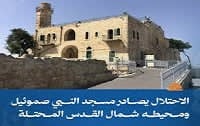
The ‘National Bureau for Defending Land and Resisting Settlements stated in its latest weekly report , that Jerusalem continues to be at the forefront of developments targeting its land, neighborhoods, and archaeological, historical, and religious heritage sites. On May 25, the Israeli Civil Administration issued an order to confiscate about 110 dunams of land in Nabi Samuel, located within the Jerusalem Governorate. The confiscated area includes the mosque, the surrounding archaeological site, a spring at its foot, agricultural lands, and the roads leading to the site, under the pretext of serving ‘public purposes’.
The confiscation order, numbered (H/02/26), represents the second instance in which the Civil Administration has expropriated land belonging to the Islamic Waqf in the occupied West Bank. Previously, in Sep. 2025, the head of the Civil Administration signed an order to expropriate land located within the compound of the Ibrahimi Mosque in Hebron, marking the first such confiscation of Islamic Waqf property.
The latest order targets the Islamic holy site of Nabi Samuel, situated 1 km from the Israeli neighborhood of Ramot, on the site of the depopulated Palestinian village of Lifta. The village was demolished by the Israeli army in 1971, forcing its residents to relocate several hundred meters eastward. In 1995, the area was designated as a national park, and archaeological excavations were subsequently conducted there.
According to Jewish, Islamic, and Christian traditions, the site is believed to contain the burial place of the Prophet Samuel. Since the 1980s, it has served as a place of worship for both Muslims and Jews, with each community praying in separate sections of the site. Despite the arrangements, the site remains under the administration of the Islamic Waqf.
Israeli Peace Now Movement commented on the confiscation order, saying: ‘Once again, we find ourselves facing decisions by the Civil Administration, led by Minister Smotrich, aimed at expanding and deepening annexation. After settlement expansion plans and unprecedented declarations of ‘state lands,’ the Civil Administration has moved to seize control of heritage sites and is now attempting to take over religious sites, creating tension in some of the most sensitive areas of the West Bank. It seems that every passing day increases the danger and creates the conditions for turning a political conflict into a religious war.”
The occupation court last week rejected the petition submitted by the Israeli human rights organization Ir Amim, in cooperation with citizens of the towns of Al-Tur and Al-Issawiya, against the settlement ‘park’ plan to be established on large areas of land northeast of occupied Jerusalem. The plan targets lands in the two towns as part of a project to link the city of Jerusalem to the “Ma’ale Adumim” settlement and the (E1) area, in a step that would restrict the natural urban expansion of Al-Tur and Al-Issawiya, by classifying the lands as a public park, which hinders the establishment of housing, schools, infrastructure, and basic services for the population.
According to the court’s decision, the occupation authorities will proceed with the procedures for implementing the plan, which is seen as part of projects aimed at strengthening the settlement connection between Jerusalem and the surrounding settlements and imposing new facts on the ground. The plan allocates about 79 dunums for residential use, with a density of up to 12 residential units per dunam ‘that is, about 950 residential units in total’, in multi-storey buildings that do not suit the lifestyle of Bedouin communities, on a steep slope that makes construction extremely difficult, and in practice it is likely that only a portion of the planned residential units will be implemented less than 100 m. from the Abu Dis landfill, where millions of tons of Jerusalem’s waste are buried for decades.
Publishing the plan for display is one of the advanced stages in the planning approval process, once building permits are approved and work begins. Here, the plan at this time is part of the government’s preparations to close the area to Palestinians, which will lead to the displacement of Palestinian communities from the area.
The occupation authorities also plan to displace Palestinian Bedouin communities from the E1 area. We note here that these authorities had published two months ago Plan no. ‘1627/7’ to expand the Al-Jabal neighborhood in Abu Dis, which was established in the 1990s for the Bedouin residents of the Jahalin, who were forcibly displaced from Israel, to expand the Maale Adumim settlement.
The Israeli Supreme Court had decided at the time that the government may not displace any community without providing alternative housing for its residents, which dictated that the occupation government allocate an area estimated at tens of dunams on the outskirts of Abu Dis, near the waste dump in the area. The new plan constitutes an important element in its broader plan to control the area east of Jerusalem.
During the past year, the government approved the construction plan in the E1 area, invited tenders for its implementation, and announced its intention to soon begin paving a road that would allow the closure of a large area of land – estimated at about 3% of the West Bank – to the Palestinians.
Within the context of a policy of ethnic cleansing practiced by the occupation government, as the Minister of Finance and Minister of Settlement in the Ministry of the Occupying Army, Bezalel Smotrich, issued a decision on May 19 ordering the uprooting of 26 Bedouin communities inhabited by about 4,856 Palestinians. The decision includes forcibly transferring these residents, including the residents of Khan al-Ahmar, to specific areas in Al-Eizariya or Al-Nuweimah near Jericho, in an ethnic cleansing campaign aimed at completely controlling the East Jerusalem desert and expanding settlement influence.
Currently, the settlers began establishing a new settlement outpost near the Khan al-Ahmar Bedouin community, adding to more than 21 outposts established in the Jerusalem Governorate, the majority of which are concentrated in the area extending from the town of Mikhmas in the north to the town of Al-Eizariya in the east. The spread of these settlement outposts comes within a plan targeting the north and east of the governorate, and aims to control more lands and impose settlement conditions in the context of tightening the noose on Bedouin communities.
As for settlement activities, it was revealed that the occupation authorities and settlement councils had begun large-scale preparations to develop infrastructure and provide secure transportation lines with armored vehicles, in preparation for the establishment and expansion of 18 new settlements and settlement outposts, especially in the Jenin Governorate. According to Israeli media, the so-called ‘Samaria Settlement Development Company’ held its annual conference in the previously evacuated ‘Sanur’ outpost in Jenin Governorate, with the participation of more than 150 drivers of bulletproof vehicles and buses. In this regard, the head of the Settlements Council in the northern West Bank, Yossi Dagan, in cooperation with the company’s management, announced that expanded transportation services for settlers will begin next year to include the new settlements to be established, besides the ‘Homesh and Sanur’ outposts.
Such steps come in preparation for the implementation of a settlement plan previously announced by Dagan, which stipulates rebuilding 4 settlements evacuated in 2005 as part of the Israeli disengagement plan, in addition to building 14 new outposts and settlements in the region, amid a broad campaign led by the Settlements Council to bring hundreds of families and settle them there. During the conference, Dagan claimed that the re-settlement in these areas represents ‘historic justice’, claiming that the plan is being implemented in full coordination with the occupation army and the Israeli security establishment in an official manner.
For its part, the management of the settlement company confirmed that it has already begun purchasing a new fleet of buses and armored and bulletproof vehicles, and recruiting new drivers, in parallel with work to rehabilitate roads and traffic hubs.
Last Wednesday, the Higher Planning and Building Council of the Smotrich Civil Administration approved a plan to construct 2,162 new settlement units in several West Bank settlements, coinciding with acceleration in the construction of settlement roads and the confiscation of Palestinian land. The approval included 1,006 settlement units in the Gvo’ot settlement within the Gush Etzion bloc south of Bethlehem, following the approval of the master plan for the new city, which the Israeli government had approved in March 2025, with the aim of accommodating more new settlers.
Approval was also granted to deposit a plan for the construction of 922 housing units in the Har Bracha settlement on Mount Gerizim in Nablus, which would expand the settlement to about three times its current size. Approval was also granted for the construction of an additional 234 settlement units in the ‘Kiryat Arba settlement’ in Hebron, in the Hampfasser neighborhood, which is in fact an independent settlement within Hebron, 800 meters north of the Kiryat Arba settlement, and separate from it.
The plan to establish the new settlement in Hebron was submitted in April 2024. The plan also includes the construction of 251 settlement units in the ‘Mevo Dotan settlement’ south of the city of Jenin, bringing the total number of settlement units approved by the aforementioned council in 2026 to 6,232 housing units. The Israeli Peace Movement commented on this, saying:
‘Since November 2024, the Higher Planning Council has been holding weekly meetings to promote the construction of housing units in the settlements. The weekly approval of plans not only regulates construction in the areas, but also accelerates its pace. For example, in 2025 the Higher Planning Council approved 27,941 housing units, an unprecedented record since the start of the settlement project in the West Bank.’
Furthermore, the occupation authorities approved a settlement structural plan for the benefit of the ‘Masua settlement’ in the Ghor al-Far’a area of Jericho Governorate, within the framework of the accelerated settlement expansion policy targeting the Palestinian Jordan Valley region, by building a new settlement unit on an area estimated at 1692 dunams, which constitutes a large expansion in the settlement structure of the settlement at the expense of Palestinian lands in the region, noting that the plan was deposited in the planning committees for the first time on Nov. 25, 2025.
Moreover, as part of the policy of de facto annexation and control over Palestinian historical and archaeological sites and the falsification of their history, the Education Committee of the Israeli Knesset, chaired by Zvi Sukkot, is discussing the ‘Judea and Samaria Heritage Authority Bill of 2026’. The bill aims to establish an authority under the Ministry of Heritage, which would assume responsibility for all aspects of excavation, preservation, supervision, and management of archaeological sites throughout the West Bank, under the supervision of the Minister of Heritage rather than the Civil Administration.
It would effectively transfer authority from the Civil Administration, which operates in the West Bank under military orders, to a civilian body subject to Israeli law. Currently, responsibility for antiquities in the West Bank lies with the Civil Administration, while the head of the Antiquities Authority oversees excavations and site maintenance in Area C. In Areas A and B, responsibility currently rests with the Palestinian Department of Antiquities.
The occupation legislation would authorize the proposed authority to confiscate privately owned land under the pretext of protecting antiquities. Similar confiscations already occur under the Civil Administration; last year, confiscation orders were issued for the archaeological sites of Sebastia and Nabi Samuel. The proposed law could allow settlers to control archaeological sites and Palestinian land on a far wider scale than has been seen under the current government.
If the law is ultimately applied to the entire West Bank, including Areas A and B, the Heritage Authority could prevent construction projects in these areas on the grounds of potential damage to antiquities. This authority already exists under both the Israeli and Palestinian antiquities systems. However, the proposed Heritage Authority would be an Israeli body empowered to intervene in any construction near or above archaeological sites. It is important to remember that virtually all Palestinian towns and villages in the West Bank are built adjacent to or above archaeological sites.
In the meantime, the Israeli Knesset passed a law at the end of last week granting tax exemptions to settlements in the West Bank. A move aims to bolster settlement activity, stem emigration from the settlements, and encourage investment in their industrial zones. Within the context, Bezalel Smotrich, head of the Religious Zionist Party and Israeli FMinister, stated: ‘Starting today, settlers are no longer second-class citizens.
The tax exemptions that have been approved, which are intended to encourage settlement, are another step towards achieving the goal of reaching one million settlers in the West Bank.’ According to the Knesset resolution, the law will be retroactive to January 2026 and will remain in effect until Dec 31, 2027. The FM, with the approval of the Finance Committee, may extend its validity by decree for additional periods not exceeding 2 years each.
List of Israeli Assaults over the Last Week Documented by the National Bureau:
Jerusalem:
- Forcing the Awadallah family to demolish 7 inhabited homes in the eastern part of Qalandia village, under the pretext of building without a permit. They also forced Fouad Aliyan, a resident of Jerusalem, to demolish his own home in the Beit Safafa town.
- Demolishing a Car Dealership in the Shuafat Refugee Camp north of Jerusalem, and the Al-Abed restaurant in the Musrara area near Damascus Gate in the city. The Jerusalem Governorate stated that the demolition of the restaurant was part of a confiscation order under the pretext of developing the area’s infrastructure. Furthermore, Ziad Sultan received a demolition order for his two-story house and commercial establishment in the Jaba’ town north of occupied Jerusalem, also under the same pretext.
- Raising the occupation flag in the courtyards of Al-Aqsa Mosque while chanting the Israeli national anthem. Extremists published a video of about 7 settlers raising the occupation flag near a staircase leading to the Dome of the Rock, opposite the Cotton Gate.
Hebron:
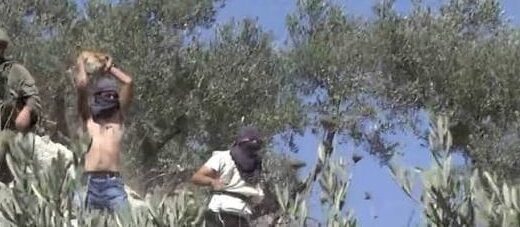
- Placing a barbed wire fence in the Beit Awa area in a move that would separate the town from the village of Saka. They also set fire to the wheat crop in the Galatia area, east of the town of Idna, in conjunction with acts of orgy they carried out in the area, and closed its road near the Idna cemetery in an attempt to restrict citizens. Moreover, they burnt large areas of wheat crops belonging to farmers from the town in the lands located adjacent to the Adora settlement and the new settlement outpost called Adorim. Settlers also tried to expel a Palestinian family from their home in the area.
- released their livestock in the vicinity of citizens’ homes in the Fateh Sidre area in the Khirbet Al-Qat in the town of Beit Umar, in Masafer Yatta.
- Handing over demolition orders for 3 homes under construction and remove the water conveying line for the Beit Al-Rush Dam, west of Hebron, which is used to irrigate about 500 dunums of agricultural land in the area.
Bethlehem:
- Installing 3 mobile homes on citizens’ lands in the Um Muhammadin area near Umm Rukba, south of Al-Khader, with the aim of expanding the borders of the settlement perched on citizens’ lands.
- Chasing the students of Kisan School as they were returning to their homes, and tried to run over them, which sparked a state of fear and panic among their ranks.
Ramallah:
- Storming the outskirts of the town of Sinjil, provoking residents. Others attacked the outskirts of the village of Deir Abu Mash’al, seizing a resident’s vehicle and pushing it off a height, causing it to crash.
- Attacking Palestinian agricultural lands by grazing their camels and sheep among the olive trees, damaging and destroying them East of the villages of Taybeh and Rammun.
- Erecting several caravans and prefabricated structures on land that had been bulldozed and had trees uprooted in the Hawd al-Sha’ab area of the Turmus Ayya town’s plain. Turmus Ayya is witnessing a continuous escalation in settler attacks aimed at seizing more of the town’s land and expanding the colonial pastoral outposts in its vicinity.
- Bulldozing large areas of the Turmus Ayya plain and uprooted hundreds of olive trees, while simultaneously constructing settlement roads and establishing new outposts in the area.
- Burning 2 vehicles and wrote racist slogans on the walls and doors of several houses in the village of Um Safa before setting fire to the vehicle of Marwan Sabah, head of the village council, and the vehicle of his brother, Muhammad Nimr.
Nablus:
- Injuring 4 citizens including an elderly man, 72, who was hit with live bullets in the foot, and another citizen, 40 was hit with live bullets and beaten, a man, 46 was also injured with bullet fragments in the face, and another, 53 was injured with live bullets in the thigh, during an attack by settlers from the new settlement outpost established on the lands of the village of Madama.
- Attacking homes in the Bir Fawza area in Beita and threw stones at the homes extensively. The attack coincided with the destruction and vandalism of a number of Palestinian vehicles that were parked in front of their owners’ homes in the area, and a settler ran over the girl, Yamama Abdel-Moumen Ahmed Abdallah, an 11th grade student at Al-Laban Secondary School and a resident of the village of Amouriya, while she was heading to her school on the main street.
- Attacking citizens in the Beita town on the road connecting the towns of Beita and Awarta, seized a number of vehicles, and targeted citizens, including children, with pepper gas, while others attacked citizens’ homes in the town of Qasra in the Ras al-Ayn area, where a young man was injured, following a settler attack on the town’s homes after he was stabbed with a knife by one of the settlers.
- Burning agricultural lands after a group of settlers closed the western entrance to the Duma village, and prevented citizens from passing through it, before setting fire to agricultural lands planted with olive trees near the entrance.
- Attacking citizens’ homes and burned dozens of dunams and olive trees in the southern area of the Madama village, amid random shooting at homes and anyone trying to reach out to put out the fire.
- Setting fire to agricultural crops in the village of Al-Laban Al-Sharqiya and Sahel Al-Sawiya, south of Nablus that led to the burning of areas of wheat crops and olive trees.
Jordan Valley:
- Carrying out demolitions in the al-Makhrouq area of Jiftlik in the northern Jordan Valley, causing damage to targeted properties.
- Attacking Palestinian vehicles on the al-Mu’arajat road between Jericho and Ramallah, and raided the Arab al-Ka’abneh community, grazing their camels amidst residents’ homes, as part of practices aimed at displacing Bedouin communities.
- Confiscating residential tents and forced the family of Muhammad Du’ais to leave their home in Jiftlik in the Jordan Valley. Moreover, they established a new settlement outpost after storming the area near Al-Auja, north of Jericho, with heavy machinery and carrying out extensive land-leveling operations to solidify the outpost.
- Issuing a military order to seize 42 dunams of land belonging to the village of Tayasir, east of Tubas, for ‘military purposes’.