المكتب الوطني للدفاع عن الارض ومقاومة الاستيطان منظمة التحرير الفلسطينية
مقالات مشابهة

Settlement Weekly Report 6 – 12 June, 2026
By: Madeeha Al-A’raj
The ‘National Bureau for Defending Land and Resisting Settlements stated in its latest weekly report , that in a striking development, former Israeli Army Minister Moshe Ya’alon likened extremist settlers who commit terrorist attacks against Palestinians in the occupied West Bank to Nazis. In an interview with the Ynet website last Sunday, regarding settler terrorism, he said, “There is a doctrine of Jewish supremacy, and this is the concept of Rabbi Dov Lior and Rabbi Ginsburgh ‘the spiritual leaders of the terrorist settlers’. What does Jewish supremacy mean? After 80 years on the Holocaust, ‘Hitler’s book on Nazi ideology’. The superior race is us, and they ‘the terrorist settlers’ promote that.’
The background for this stance stems from Ya’alon’s recent tour of the West Bank, during which he sought to witness firsthand the settlers’ terrorism against Palestinians. He had learned that an officer under his command in the General Staff Reconnaissance Unit ‘the elite commando unit of the Israeli army’ had gone to assist Palestinians in the Beita town and was struck in the head by a stone. When Ya’alon contacted the officer at the hospital, his daughter informed him that he was in no condition to speak and that he had filed a complaint with the police, who had yet to take his statement.
Ya’alon emphasized the settlers’ brutality towards Palestinians, stating, ‘I am ashamed that my own people are carrying out such acts, and this is being done at the direction of the government. The Hagammer unit is running rampant there,’ adding, ‘What is happening there will forever be a disgrace. The Israeli government is encouraging Jewish aggressors to seize Arab lands through violence, including shootings.’ There are more than 20 cases of Palestinians being killed and no one has been arrested. Some of them are wearing the uniform of the ‘Hagmar’ a unit in the Israeli army that includes extremist settlers, and some of them are wearing civilian clothes. There is no police, because Ben-Gvir instructed the police brigade there not to work, and the Jewish brigade in the Shin Bet is paralyzed.
Ya’alon, continued, ‘When I was commander of the Judea and Samaria Military Division and commander of Central Command, I worked as much as I could to ensure that Yeshayahu Leibovich ‘the leftist Jewish thinker’ was not right when he claimed that the occupation would turn us into Nazi Jews. I believed that controlling the region was correct until there was an agreement, and of course not to reach situations like this. I cannot say today that he was not right, and I hope that the next government will reverse this situation.’
He isn’t the only one who describes settler violence as terrorism. Former Israeli PM Ehud Olmert previously accused settler violence of murder, days after Netanyahu appeared to downplay the importance of the escalation of their attacks on the Palestinians. In an article published in the Israeli newspaper Haaretz, about a year ago, Olmert said that the violence practiced by Israeli settlers against the Palestinians is not just the work of fringe extremists, but rather a coordinated campaign protected and encouraged by politicians, police, and military authorities, and is designed to gradually lead to ethnic cleansing and mass expulsion, and that the settlers are not just extremists.
‘It is not a gang of ‘hilltop youth’ or a small group of delinquents who violate the rules of proper behavior. It is a militia. Military, terrorist and violent killing, burning, beating, shooting and destroying in a systematic, planned and organized manner everything that is non-Jewish in the territories,’ adding, ‘Jewish terrorists in the territories do not operate in isolation from a very broad segment of supporters, who represent the various arms of the government, the Council of Ministers, the police and the army.’
Barak, also a former prime minister, described settler violence in the occupied West Bank as ‘terrorism’, and accused Benjamin Netanyahu’s current government of encouraging them. He considered the attacks carried out by settlers against Palestinians and their property to be terrorism supported by political cover, and directly accused Netanyahu’s government of encouraging this violence and providing protection to its perpetrators, warning of the consequences of these policies on the future of Israel.
In turn, Yair Golan, who heads the Democratic Party in Israel, in similar statements, sparked widespread controversy in Israel and abroad, due to comparisons that warned of practices similar to those of Nazi Germany. His most prominent statements were those he issued in 2016 when he was serving as Deputy Chief of Staff of the Israeli Army, and they sparked a political storm on ‘Holocaust Remembrance Day’ when he said, “If there is something that scares me on Holocaust Memorial Day, it is learning about the horrific operations that took place in Europe in general and Germany in particular 70 years ago, and finding evidence of them among us today.’
The statement was seen as a warning of growing fascism and racism within Israeli society. After entering the world of politics in 2019, Golan likened the rise of the extreme right in Israel to the rise of the Nazis to power, explaining in a radio interview that ‘the Nazis rose to power democratically’, and warned against extremist parties exploiting Israeli democracy to create a reality of totalitarian rule. These statements have been repeatedly used in political speeches against him. Netanyahu and other right-wing officials attacked him, recalling his previous positions in which he compared some Israeli occupation practices and policies to Nazi Germany.
In spite of the claim that there is no ideology or rabbis behind these terrorist attacks, political and media circles in the occupying state point out on many occasions that the settlers who participate in these attacks are students of Rabbis Yitzhak Ginzburg, David Dudkevich, and Yitzhak Shapira, who head the religious school in the ‘Yitzhar settlement’, which is considered one of the most prominent strongholds of the extremist settlers. It is noteworthy that Rabbi Shapira is the author of the book ‘The King’s Doctrine’, which allows the killing of civilians, children, women, and the elderly, non-Jews, and still raises loud controversy in Israel.
Within the context, it has emerged again that the current Israeli government is financing Jewish terrorism. A short time ago, extremist settlers vandalized the vehicles of Palestinians who were accompanied by activists from the ‘Bnei Abraham Preventive Presence’ group near the Halhul town. The army arrived at the site and declared the area a closed military zone, then removed the activists and left the settlers at the site.
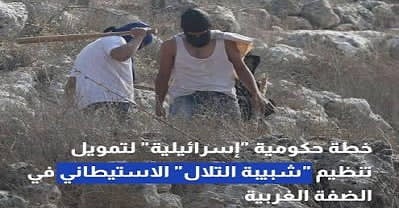
After the army left, the settlers returned to harass the activists again. At the same time, Amir Ettinger published on the Ynet website that the government would allocate NIS 5.5 million to fund food and clothing for what is known as the hilltop youth, so that they do not lack anything as they attack the Palestinians and the Preventive Presence activists.
As well, European Union foreign policy official Kaya Kallas compared Israel’s treatment of the Palestinians in Gaza and the West Bank to the apartheid policies pursued by white governments in South Africa, which ended irreversibly in the early 1990s, during closed and secret meetings with representatives of the Mexican government. Officials and diplomats, including people who attended the meeting, said that Callas spoke about how affected she was by a visit she made last year to South Africa and the Apartheid Museum in Johannesburg, which sparked uproar in political circles in the European Union as well as in Israel.
Media outlets said that while the governments of Ireland and Spain show some sympathy with this proposal, the European Union has clearly avoided adopting such comparisons, which have been categorically rejected by countries including Germany and France.
As for settlement activities and the ‘Karnei Shomron settlement’, which was established by the occupation authorities in 1978 on the lands of the villages of Kafr Laqif, Jinsafut and Dirsitia in Wadi Qana between the governorates of Qalqilia and Salfeet, it was announced last week that the signing of a comprehensive agreement was described as ‘historic’ in favor of the settlement, with an estimated value of about NIS 2 billion.
The Minister of Finance and Minister of Settlement in the Ministry of the Army, Bezalel Smotrich, said that the time has come to decide also in the West Bank and impose Israeli sovereignty over it even before the elections. Occupation Army Radio also quoted a political source as saying that the agreement includes the establishment of 6,000 new housing units, in addition to extensive investments in infrastructure, public buildings, the education and culture sectors, transportation networks, commercial areas, and employment areas, in addition to projects to develop public space within the settlement.
Netanyahu was scheduled to participate in the event announcing the agreement, but he canceled his participation due to security developments in Lebanon and the raids on the southern suburbs of Beirut. During a speech he delivered at the event, Smotrich said, addressing Netanyahu: ‘The time has come to decide also in the West Bank and impose Israeli sovereignty over it even before the elections.’
In Hebron, during the ceremony announcing the establishment of a new settlement called ‘Doron’ in Mount Hebron, the Minister of Finance and the Minister of Settlement in the Ministry of the Army said that the so-called ‘Supreme Planning Council’ in the ‘Civil Administration’ unit approved the withdrawal of planning and building powers from the Hebron Municipality, in accordance with the ‘Hebron Agreement’ between Israel and the Palestine Liberation Organization.
The Israeli political-security cabinet had approved this step several months ago based on a proposal submitted by Smotrich, according to which the planning and construction powers in the settlement outposts in Hebron and in the Ibrahimi Mosque would be withdrawn from the Hebron Municipality and transferred to the occupation authorities in a step that Israeli political circles see as a move to legitimize many of the settlement outposts established by the occupation authorities in the city in flagrant violation of the so-called Hebron Protocol Between the Israeli government and the Palestine Liberation Organization in 1997.
Smotrich said in a statement in this regard, ‘Yesterday, we canceled the Hebron Accords. For years, one of the most contradictory provisions of Oslo remained as it was, while the powers related to the Jewish settlement in Hebron and the holy places were related to the municipality of terrorism in Hebron, and we put an end to that, yesterday,’ adding ‘This is much more than a planning step, this is a corrective step. We are continuing the revolution of legitimizing settlements, strengthening governance, and deepening Israeli sovereignty in -Judea and Samaria-’ referring to the annexation plan.
In Jerusalem, Israel’s policy of ethnic cleansing against residents of several neighborhoods continues. Last week, the Israeli Supreme Court rejected an appeal filed by residents and issued a final ruling ordering their eviction from their homes in Silwan in favor of settlers affiliated with the Ateret Cohanim organization. The settlers are expected to begin the eviction process soon, and unless the government intervenes to halt the evictions -which it is unlikely to do – some 12 families, comprising dozens of Palestinians, could be forced to leave their homes within months.
The Peace Now movement commented, ‘Unfortunately, there is no other term to describe this situation other than ethnic cleansing.’ Human Rights Watch, for its part, confirmed that Israeli authorities are accelerating home demolitions and forced evictions of Palestinian residents in Silwan, in occupied East Jerusalem. The organization stated that the forced displacement or transfer of residents within or outside occupied territory violates international humanitarian law and constitutes a war crime, unless temporarily justified to protect the residents themselves.
It is well-established that international law prohibits such measures, which amount to forced displacement and ethnic cleansing, as stated in the advisory opinion of the International Court of Justice issued in July of last year. The Court indicated in this regard that this policy constitutes a violation of international law. It is worth noting that since 1967, the Israeli government has confiscated about one-third of East Jerusalem’s land to construct 55,000 housing units for Israelis.
List of Israeli Assaults over the Last Week Documented by the National Bureau:
Jerusalem:
- Destroying water lines supplying the Al-Ara’ara Al-Mahtoush and Al-Tabna communities in Khan Al-Ahmar village, east of Jerusalem.
- Building a new settlement road extending from the Bedouin community towards Palestinian-owned land in the Al-Khunaidiq area of Beit Anan town, northwest of occupied Jerusalem.
- Demolishing residential and agricultural structures belonging to the Al-Zawahra family in the Khallat Al-Sidra Bedouin community in the town of Mikhmas, claiming they were built without permits.
- Confiscating equipment and uprooted trees from the land of Jerusalemite Khaled Al-Zeer in the Silwan Neighborhood.
Hebron:
- Attacking homes and spray-painted racist slogans on a mosque in the town of Beit Ummar in the Safa area.
- bulldozing work in the Jabal Tarousa area west of Dura, in preparation for establishing a new settlement.
- Launching a demolition campaign, destroying 2 agricultural sheds belonging to Khalil Issa Raba’i, 2 brick and corrugated iron houses belonging to the brothers Mu’ayyad and Zaid Khalil Raba’i, a concrete wall belonging to Mahmoud Issa Raba’i, and a 120m2 brick and corrugated iron house belonging to Ahmed Issa Raba’I, and uprooted about 20 fruit trees during the demolitions in Masafer Yatta, in the Ighziwa area of the town of Al-Karmel.
- Demolishing a house under construction and a 130-cubic-meter water well, and uprooted a number of fruit trees belonging to Rawdi Abu Aram Al-Jabarin in the Ma’in area of the town of Al-Karmel,.
Bethlehem:
- Storming the Khala’il al-Luz area, southeast of Bethlehem, and vandalized property before stealing water pipes from near the reservoir that supplies the area with drinking water.
- Attacking employees of the Jerusalem District Electricity Company while they were working in Wadi Rahal, south of Bethlehem, injuring several of them slightly and causing significant damage to their vehicle.
- Filling agricultural land in the Wadi Jamala area, west of Nahalin, with earth and rocks. This land, planted with about 200 olive trees, was targeted to expand the settlement’s perimeter fence and seize nearly 200 dunams of the valley, which has been subjected to years of attacks through the dumping of wastewater, damaging hundreds of grapevines, almond trees, and peach trees in the Ma’in area of the town of Al-Karmel.
- Damaging scores of olive trees belonging to Ismail Abdullah Ghazal in the Umm Zuwaitina area in the village of Kisan, east of Bethlehem,.
Ramallah:
- Burning the Grand Jaljaliya Mosque, east of Ramallah, and the Mazara’ al-Nubani Mosque, north of the city, and wrote racist phrases in Hebrew on the walls of the 2 mosques. It should be noted here that Jaljaliya is subjected to continuous, almost daily attacks, including the theft of sheep and property, in addition to the displacement that affected the Bedouins there.
- Attacking the outskirts of the village of Ein Arik, and citizens confronted them, which led to an outbreak of violence.
- Firing live bullets at citizens in the Deir Abu Mishal village, injured 4 citizens, one of them in serious condition, during a settler attack on the villagers, shortly after they succeeded in dismantling a settlement outpost in the ‘Al-Qarani’ hill area.
- Storming the Qatrawani Shrine and Park, cut the barbed wire surrounding the park and wandered inside it in the town of Atara, while others cut a road linking the town of Beitunia and the village of Beit Ur, and prevented citizens from moving through it.
- Burning 2 vehicles and destroyed two others during an attack they carried out on the town of Deir Dibwan in the Al-Marah area.
- Attacking farmers in the plain area of the town of Sinjil while they were harvesting wheat, and tried to forcefully prevent them from completing the harvesting work.
- Attacking a vehicle and caused serious material damage to it in the town of Ain Yabrud.
- Destroying the main water line supplying the village of Um Safa as they bulldozed citizens’ lands and built a road in the Al-Harsh area between Um Safa and the neighboring village of Deir Al-Sudan.
Nablus:
- Attacking the village of Odla, south of Nablus, and threw Molotov cocktails at the well that supplies the village with water, causing fires to catch on in the nearby lands.
- Attacking farmers in the area belonging to Burqa lands amid attempts to expel them from the area, in the Masoudiya northwest of Nablus. They tried to storm the house of citizen Musa Idees, which led to him being injured in the hand, and they damaged a vehicle after smashing its windows. They set fire to cultivated fields, burnt areas of wheat and damage agricultural crops before civil defense crews intervened to put out the fires.
- Attacking the home of Um Ayman Soufan and threw stones at it, causing a state of terror and material damage to the place in the village of Burin.
- Attacking 2 Palestinian vehicles on the road connecting the village of Al-Laban Al-Sharqiya and the city of Salfeet, which led to material damage to them.
Qalqilia:
- Setting fire to land and vehicles and damaged a number of homes in the village of Jit. Local sources reported that a number of settlers set fire to agricultural land belonging to more than 4-5 families from the village, causing it to burn, before civil defense crews, accompanied by young men from the village, were able to control and extinguish the fires.
- Throwing Molotov cocktails towards a number of homes in the village, causing minor material damage to 3 homes. All of these properties belong to the Al-Sadda, Yamin, and Abu Bakr families in the village.
Jenin:
- Storming the town of Arraba and closed the main road between Arraba and Ya’bad. In the eastern town of Barta’a, the occupation forces resumed demolition operations. The mayor of Barta’a Al-Sharqiya, Ghassan Qabha, said: ‘Large forces from the occupation army stormed the ‘Khorat Al-Dabaa’ area in the town isolated by the apartheid wall, accompanied by bulldozers, and began demolishing a ten-story residential building and nine inhabited houses, which led to the displacement of more than 20 new families who became homeless.
- Bulldozing land in the Al-Jabriyat Neighborhood in the center of the city of Jenin, with the aim of establishing an army camp on the land despite the fact that its owners have official ‘tabu’ papers proving their ownership of it. He indicated that they were informed of the decision to seize it, under the pretext of using it for Israeli military purposes.
Jordan Valley:
- Bulldozing operations to pave a military road in the Atouf plain after they stormed the fertile plain east of Tammoun. This coincided with the continuation of extensive bulldozing of agricultural lands as part of a project to pave a military road linking the Ein Shibli and Tayasir checkpoints, with a length about 22 km. The bulldozing operations resulted in the destruction of areas of land, networks, water transmission lines, and damage to crops, after the occupation notified of the seizure of more than a thousand dunams in Tammoun, Atouf, Tubas, and the surrounding areas to pave the road.