Settlement Weekly Report 7 – 13 Nov, 2026
By: Madeeha Al-A’raj
The ‘National Bureau for Defending Land and Resisting Settlements “ stated in its latest weekly report , that the lands of Ein Al-Duyuk Al-Tahta, located 2 km west of the Jericho city, constitute a vital agricultural area in the Jordan Valley being very close to the city centre, are subjected to repeated settler attacks, most of which originate from the ‘Qusur Farm Outpost,’ established in the area 2 years ago. In Feb. and July of this year, settlers demolished about 13 houses in the village without any legal justification, while continuing their repeated assaults on Palestinian residents.
In late Oct. coinciding with the Knesset elections, settlers arrived the village and launched extensive operations to install fencing and lay infrastructure, they broke into Palestinian houses, stole equipment, assaulted residents, and erected a gate blocking an entire street, effectively cutting off access to dozens of Palestinian homes.
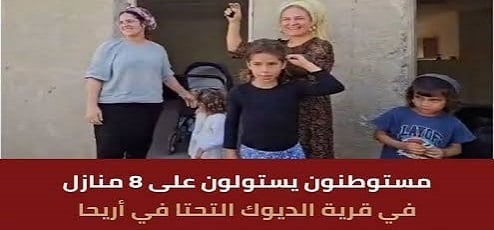
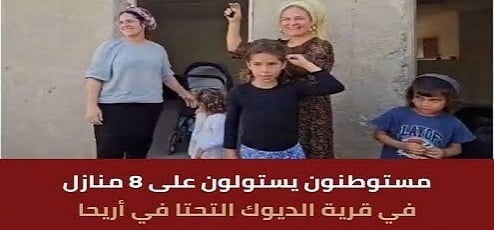
Last week, about 30 settlers, moved to 8 buildings in ‘Ein Al-Duyuk Al-Tahta,’ supported by the ‘Nahala Settlement Movement,’ which was founded in 2005 by the racist Rabbi, Moshe Levinger, and Daniela Weiss, one of the prominent settler leaders and the ‘Binyamin Regional Council,’ which is headed by Yisrael Katz. It is considered the largest Israeli settlement regional council in the occupied West Bank in terms of area and population.
It is responsible for managing and providing infrastructure and services for scores of settlements and random settlement outposts extending in the middle of the West Bank, specifically in the Ramallah, Al-Bireh and Jerusalem governorates, all the way to the eastern slopes of the Jordan Valley. The goal of the step was not only these 8 buildings, but rather the establishment of a settlement in the place that creates a reality similar to what exists in the city of Hebron, as described by the Israeli ‘Peace Now Movement,’ where the Israeli army has a burden of protecting an Israeli presence in the heart of a Palestinian neighborhood.
In Hebron, the Israeli presence within the Palestinian city led to constant friction and violence, the imposition of strict restrictions on the freedom of movement of Palestinians, and the application of a system of apartheid. This situation also resulted in the displacement of thousands of Palestinians from their homes and the closure of entire streets to them. The move sparked widespread reactions after it became clear that it was carried out in collusion between the occupation army, especially the leadership of the central region, and settler leaders.
The Commander of the Central Region, General Avi Ballut, knew in advance the intention of the settlers and members of the ‘Nahla Movement’ to enter those homes, which are located at the entrances to Jericho, according to information published by the ‘Haaretz Newspaper’ and confirmed by informed Israeli security sources. According to those sources, Ballut met with those concerned the day before entering, but he asked not to inform the leaders of the military and security sectors until the settlers settled in the area.
According to ‘Haaretz,’ senior security officials familiar with some of the details of this case confirmed, including the existence of preliminary talks before entering between representatives from the ‘Binyamin Regional Council,’ members of the ‘Nahla, and the Regional Officer, Lieutenant Colonel Elitzur Trabelsi, who was involved in the coordination. The sources said, according to the newspaper, that the participants put the final touches on the details of the operation, including the time of entry and how to inform the army commanders of the information.
The settlers’ entry prompted the Israeli occupation army to deploy 3 combat platoons to protect them. According to the army’s spokesperson, the entry turned into a security operation requiring the deployment of forces from the regional territorial system in the area. According to a report published by Channel 16 on Thursday, PM Netanyahu and Army Minister Katz were briefed on the operation shortly after the 8 families entered the houses. Settlement and National Missions Minister Orit Strock also visited the houses occupied by the families, accompanied by Hannah Ettah, Deputy Head of the Binyamin Regional Council, and Daniella Weiss, head of the Nahala Movement. Strock said the move was ‘a continuation of the process of rectifying the damage caused by the Oslo Accords,’ adding that ‘the next stage is returning to the Gaza Strip.’
Palestinian official data and the ongoing investigations on the issue of seizing the houses in indicate strong suspicions of forgery and legal fraud managed by settlement groups to seize real estate. The Palestinian Land Authority and the Jericho Land Registry Department confirmed that they haven’t issued any records, plans, or ownership transfer documents to any Israeli or settlement party, and haven’t conducted any official transactions on these plots. Israeli Channel 12 also published a report in which it confirmed that after conducting a full examination with the ‘Israel Lands Authority,’ it was found that there is no comprehensive legal documentation proving settlers’ ownership, and that the issue most likely involves widespread forgery in documents and agencies.
Legal experts also explained that settlement associations such as the ‘Nahala Movement,’ due to their rush to establish settlement outposts, often resort to fictitious companies registered with the Civil Administration, and forge periodic agencies, or initial sales contracts, or sign on behalf of deceased persons or expatriates outside the country to legitimize their position on the ground.
Human rights organizations, such as the Israeli ‘Peace Now’ also confirm that even if the settlers claim the existence of purchase contracts ‘which are invalid and forged in this case,’ the establishment of a new settlement outpost requires official political approval and purchase permission from the army commander, which reveals the danger of silent complicity by military leaders such as Avi Ballut to pass the incursion as a fait accompli without declared government approval.
Separately, a report by the Israeli organization Ir Amim revealed the involvement of 19 government bodies affiliated with 8 Israeli ministries and agencies in the displacement of Palestinians and the seizure of their properties in occupied East Jerusalem, in favour of settlement expansion and the Judaization of the city. The Jerusalem-focused organization documented the roles of these bodies in forcibly evicting Palestinians and confiscating their land and properties.
It stressed that displacement operations are no longer limited to settler organizations such as Ateret Cohanim and Elad, but are increasingly being carried out directly by Israeli authorities on a wider scale. The involvement of government ministries in these operations has become more overt since 2023, as part of policies targeting the Palestinian presence in East Jerusalem. In this context, the organization reported that Israeli authorities demolished 181 homes in East Jerusalem in 2024, compared with an annual average of 50 before 2019.
Six Palestinian neighborhoods face the threat of displacement, including 3 in Silwan, Sheikh Jarrah, Um Tuba, Walaja and Nu’man. Around 115 houses in al-Bustan Neighbourhood and 45 homes in the Nu’man village are also at risk of demolition. The report further stated that Israeli authorities have confiscated 35% of Jerusalem’s land since its occupation in 1967 and issued tenders for the construction of 60,000 settlement units. It also recorded an increase in the average annual number of home demolitions to 131 since 2019, compared with 50 per year before that.
According to the organization’s report, Israeli institutions play complementary roles in implementing these policies. The Ministry of Justice, through the General Custodian and land registration offices, facilitates the transfer of properties into the hands of the state and settler organizations. Meanwhile, the Ministry of Finance uses the powers of the Custodian of Absentees’ Property to seize Palestinian properties.
The Ministry of Construction and Housing and the Israel Land Authority advance settlement construction projects on confiscated land, while the Ministry of Interior and planning bodies approve settlement plans and restrict construction in Palestinian neighborhoods. The Ministry of Jerusalem Affairs and Heritage funds settlement projects, while the Ministry of National Security, the police and law enforcement agencies participate in demolition and eviction operations. The Israeli Jerusalem Municipality, in turn, promotes settlement expansion plans and enforces demolition orders against Palestinian homes.
In terms of settlement activities, the occupation authorities plan to establish 42 settlements in the northern West Bank. The director of the North Directorate of the Wall and Settlement Resistance Authority, Moh’d Azem, said that the establishment of these settlements comes within the framework of a plan aimed at dismembering the region, isolating its governorates, and creating a change in its demographic composition, and that the Nablus and Jenin governorates are witnessing an unprecedented settlement escalation, and that the occupation government announced the establishment of 9 new settlements in the Nablus Governorate alone, and has already begun implementing work related to establishing its infrastructure, including water, electricity, and road networks.
According to the Commission’s data, during the three years of the war of extermination on the Gaza Strip, 211 settlement outposts were established in the West Bank, mostly of a pastoral nature, including 62 in Ramallah and Al-Bireh, 57 in Hebron, 38 in Nablus, 29 in Bethlehem, and 15 in Jerusalem, and the rest are distributed among the rest of the governorates. Israeli planning authorities also studied 415 settlement plans and issued 97 bids, including the construction of 15,760 settlement units. Of these, 84 bids were in the West Bank, including 12,872 units, and 13 bids were within the municipal boundaries of Jerusalem, including 2,888 units.
In Bethlehem Governorate, on the 28th of last month, the Israeli occupation authorities issued four military orders targeting 15 dunums of land in several areas: Al-Khader, near the Efrat settlement, for the construction of a military tower, Arab Al-Ta’amra, near the Tekoa settlement, under the pretext of security, Nahalin, at the site of Tur Al-Batiya, near the Neve Daniel settlement, and the area surrounding Khirbet Beit Skariya and Beit Skariya, near the Rosh Tzurim settlement. The orders provide for the seizure of portions of land and the removal of olive, almond and pine trees, threatening agricultural land and the livelihoods of their owners.
Landowners have been given only seven days to file objections, placing them under immediate time pressure. The orders remain in force until 31 Dec. 2028, while farmers have just 7 days to comply with the removal orders or submit objections. The significance of these military orders extends beyond the confiscation of limited areas of land. They risk creating a new security and settlement reality that isolates Palestinian villages and constrains their natural expansion and agricultural development, in favour of the settlements of Efrat, Tekoa, Neve Daniel and Rosh Tzurim, at the expense of surrounding Palestinian communities.
In Ramallah and Al-Bireh, the Civil Administration has issued a military order to seize 26 dunums of land belonging to the towns of Deir Nizam, Um Safa, and Atara for the construction of the ‘Ateret–Neve Tzuf emergency route.’ This move restricts landowners from utilizing their property and strengthens the connectivity between settlements at the expense of Palestinian territorial contiguity. The repercussions of this land seizure extend well beyond the area directly covered by the military order, they also affect adjacent lands due to the imposition of security restrictions, the creation of obstacles for landowners attempting to reach their fields, and the alteration of established routes for movement and transit.
In Hebron, the Israeli occupation authorities announced the approval of an allocation of 3,039 dunums of land for the establishment of a settlement industrial zone named ‘Mevo ot Lachish.’ The move was jointly undertaken by the Settlement Administration at the Israeli Ministry of Army and the Israeli Civil Administration, with the direct support and follow-up of Minister Smotrich.
The industrial zone is planned for an area extending between the towns of Tarqumiya, Beit Ula and Nuba, west of Hebron, as part of several settlement projects being advanced in areas adjacent to the Green Line. These projects aim to link settlement blocs in the southern West Bank to Israel, including the city of Kiryat Gat and Route 6, thereby reinforcing the security and military settlement belt around the governorate and geographically isolating its towns.
According to statements by Yaron Rosenthal, head of the Gush Etzion Settlement Council, the industrial zone is expected to generate income and tax revenues estimated at more than NIS 100 million annually for settlement councils. The approval has raised widespread Palestinian concerns over the anticipated confiscation of vast areas of agricultural and grazing land, as well as the denial of any prospects for urban or economic expansion to the surrounding Palestinian towns.
In Jordan Valley, the Walla news website revealed a settlement plan led by the Ministry of the Occupying Army along the border with Jordan, which includes establishing about 40 settlement points, constructing a 500-km long border wall, widening Route 90, in addition to developing agricultural, economic, and infrastructure projects, with the aim of doubling the number of settlers in the region during the next ten years.
The plan calls for large-scale engineering operations, including removing old minefields, in preparation for preparing the lands to establish infrastructure in a project estimated to cost about NIS 2 billion. The plan isn’t limited to the settlement and military aspects, as it also includes economic projects, including the establishment of server farms to serve the artificial intelligence industry, and facilities for producing renewable energy.
List of Israeli Assaults over the Last Week Documented by the National Bureau:
Jerusalem:
- Issuing demolition orders for 4 residential and agricultural structures in the Abu Al-Nawar Bedouin Community, near the Al-Eizariya Town, days after they issued a notice to close the only road leading to this community, as well as to the areas of Wadi Al-A’waj and Al-Muntar.
- Attacking houses in another Bedouin community in the Al-Tibna area, near Khan Al-Ahmar, threw pelting residents with stones; the local inhabitants confronted them and stoned them.
- Invading the Maa’zi Jaba’ Community, drove Tractions in provocative way among the residents’ houses. In Jabal al-Mukabbir,
- Compelling 2 Jerusalemite residents to demolish their own homes in the al-Sal’a Neighborhood in the Jabal Al-Mukabbir. Moreover, they demolished a vehicle showroom in the Hizma town.
Hebron:
- Storming Hebron’s Old City, hundreds of settlers entered the area after the occupation authorities closed the Ibrahimi Mosque to Muslim worshippers, citing Jewish holidays. The authorities also sealed off several neighbourhoods, including Jaber, Al-Salaymeh, Wadi Al-Nasara, Wadi Al-Hussein, and Tel Rumeida, preventing residents from entering or leaving their houses to facilitate settlers’ arrival and celebrations.
- Attacking Palestinian houses in the Wadi Al-Rakhim area, south of the city, leaving several residents with bruises and contusions. Moreover, settlers, accompanied by Israeli occupation forces, assaulted Palestinians harvesting olives in Khillet Al-Furn, part of the village of Birin, seizing a tractor and stealing olive crops.
- Attacking the family of Atallah Al-Hamamdeh while they were harvesting olives, forcibly driving them off their land in Wadi Ma’in, in the Masafer Yatta area.
- Establishing a new outpost in the Hamsa area, south of Hebron, and stole olives from Palestinian-owned lands in Khillet Al-Homs, also in Masafer Yatta.
- Storming Palestinian agricultural land in Khirbet Al-Kharaba, east of al-Samu’, and released their livestock into the fields, causing extensive damage to crops.
Ramallah:
- Seizing an agricultural tractor in the village of Al-Mughayir belonging to the citizen Amin Saleh Abu Alia. They deliberately emptied the waste that was loaded inside the tractor and threw it at the entrance to the Al-Mughayir Boys’ Secondary School.
- Storming the house of the citizen Khaled Daoud in the Al-Marajem area, located between Al-Mughayir and Duma, and carried out provocative actions against citizens and their property in the house.
- Vandalizing agricultural land in the Gharaba area, west of the Sinjil town. They destroyed the fence and gates surrounding it.
- Attacking citizens’ lands and assaulted their property in Deir Abu Mishal. While others attacked farmers in the town of Sinjil while they were picking olives in the Al-Batin region, they seized a citizen’s vehicle.
- Setting fire to a number of olive trees, and others attacked olive pickers in the village of Aboud, while they were heading to the Al-Dahadih area, and prevented them from reaching their agricultural lands or returning to their homes, before the people of Deir Abu Mishal supported them and ensured their safe return to their homes.
Nablus:
- Attacking farmers in the Beita town in the Dhahra region and stole the olive crop and agricultural equipment, burned three drilling machines and a number of vehicles and equipment belonging to stone sawmills in the industrial zone of the town, while the occupation forces stormed the town in conjunction with the attack
- Injuring a journalist and a foreign activist as a result of an attack launched by settlers on olive pickers between the towns of Qasra and Jalud.
- Cutting electricity poles supplying the Soufan family’s house in the village of Burin near the ‘Yitzhar settlement.’
- Stealing olives from the farm of citizen Fadi Masoud in the Al-M,asodiya area. The occupation bulldozers also continued to bulldoze lands and uproot olive trees near the Al-Laban Al-Sawiya School.
Tulkarm:
- Announcing the issuance of a notice by the Israeli Civil Administration, the municipality of Kafr Al-Labad reported the deposit of detailed structural plan no. 158/5/1 and an amendment to detailed plan no. 158/2, both related to settlement expansion in the vicinity of the ‘Avnei Hefetz’ settlement, southeast of Tulkarm.
- Injuring a Palestinian resident in the village of Beit Lid, when a group of settlers attacked farmers while they were harvesting olives.
Qalqilia:
- Sealing agricultural equipment in the lands located between the villages of Kafr Laqif and Hajjah, east of Qalqiya, including 4 large olive harvesting mats, in the area located near the settlement outpost established between the two villages.
- Notifying to demolish the Popular Resistance Tent in Izbat Al-Tabib, east of Qalqilya
Jenin:
- Preventing farmers from harvesting olives in the Heesh Fires area of the Anin lands, adjacent to the site of a new settlement outpost in Khirbet Suruj.
- Seizing an agricultural tractor and quantities of the olive crop, and detained a number of citizens while they were picking olives on their lands west of the town of Araba, while settlers stormed agricultural lands and stole the olives. In the Al-Harayeq area of the town.
Salfeet:
- Injuring 3 young men as a result of settlers attack in the Wadi Al-Shaer area, east of the city of Salfeet, while others attacked several vehicles belonging to citizens from the villages of Al-Laban Al-Sharqiya and Amuriyah, in the Wadi Al-Shaer area near Al-Zaytouna University.
Jordan Valley:
- Stealing agricultural equipment east of the town of Tammoun used to irrigate a grape vineyard belonging to the citizen Nazir Bisharat in the Al-Tha’la area.
- Spraying organic fertilizer on citizens’ lands in the Burj area in the northern Jordan Valley, in preparation for planting them with rain-fed crops.
- Destroying agricultural crops and plastic houses in the village of Al-Duyuk Al-Tahta. The attacks affected tens of dunums of cultivated land.
- Injuring a citizen as settlers attacked a group of citizens while they were picking olives near the town of Tayasir, east of Tubas.
- Attacking a citizen’s plastic house and tore it apart using sharp tools in the northern Yarza community, east of Tubas.