Settlement Weekly Report 6 – 12 June, 2026
By: Madeeha Al-A’raj
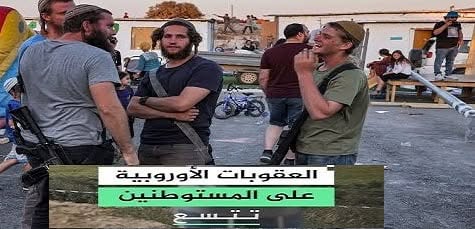
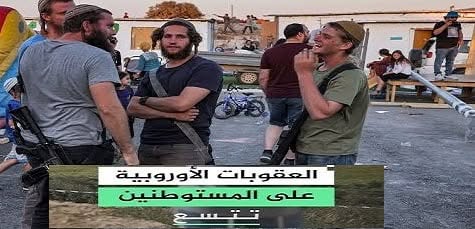
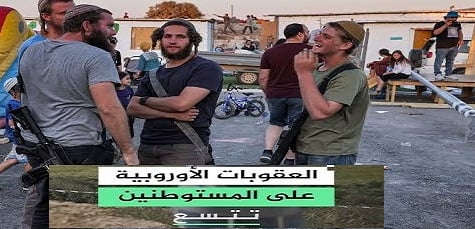
The ‘National Bureau for Defending Land and Resisting Settlements stated in its latest weekly report , that last Tuesday, France, Britain, Canada, Australia, New Zealand, and Norway jointly announced sanctions against 4 leaders of settlement organizations, 21 settlers in the West Bank, and Israeli FM and Minister of Settlement Affairs Smotrich. The measures were imposed in response to what the 6 countries described as the ‘horrific violence’ committed against Palestinians in the occupied West Bank. Explaining the decision to bar Smotrich from entering France, French FM Jean-Noël Barrot stated that the Israeli minister has openly advocated for the annexation of the West Bank, the establishment of new settlements, and the reoccupation of Gaza, while also pursuing policies aimed at accelerating the economic collapse of the Palestinian Authority.
Barrot warned that this would have dire consequences for the Palestinian people and is a policy unacceptable to the overwhelming majority of the international community, which remains firmly committed to the two-state solution. Smotrich, who leads the far-right Religious Zionist Party, a member of Netanyahu’s governing coalition, is the second Israeli minister to be barred from entering France in recent months.
Last month, Paris barred National Security Minister Itamar Ben-Gvir from entering the country after he released a video showing the mistreatment of detained activists from the ‘Steadfastness Flotilla’, which attempted to deliver humanitarian aid to the Gaza Strip. Ben-Gvir and Smotrich are key figures in the government of Netanyahu, who is wanted by the ICC on charges of genocide and war crimes.
Ireland recently barred the 2 ministers, and Britain barred them from entering in June of last year, before other countries, including Spain and Slovenia, followed suit. The British government also announced it would impose sanctions on 6 entities and one individual involved in financing, enabling, and carrying out settler violence in the West Bank.
The move comes amid escalating violence by Israeli settlers in the occupied West Bank and reflects growing anger in many Western countries toward PM Netanyahu’s government, which has expanded settlement construction with the aim of undermining the prospects for a Palestinian State. European diplomats say that with efforts within the EU to push for tougher measures against Israel faltering, several countries have concluded that coordinated, country-by-country sanctions are the best option at present.
Responding to these countries, the Israeli Foreign Ministry announced its rejection of what it described as ‘disgraceful measures’ that it took against ‘Israelis, Israeli entities, and a government minister’. The Minister of Foreign Affairs of the occupying state, Gideon Sa’ar, accused the governments that announced the sanctions of abject failure in combating what he claimed was ‘rampant anti-Semitism’ in their countries. He considered that the aforementioned countries were seeking to impose a political position on ‘the right of the Jews to live in the Land of Israel, and the Israeli-Palestinian conflict, under the guise of combating violence.’
Within the context, British PM Keir Starmer is facing increasing pressure from within his party, after more than a third of the Labor Party members in the House of Commons signed a letter demanding that the government stop trade with Israeli settlements in the occupied West Bank, considering that this step represents a necessary response to the escalating violations against the Palestinians. The letter was signed by 137 MPs out of 402 representing the Labor Party in the British Parliament, calling on the government to take tougher measures towards Israeli policies in the occupied Palestinian territories.
They stressed that ‘there is an urgent need for accountability and to impose tangible consequences on Israeli violations in the West Bank and Jerusalem,’ noting that stopping trade with settlements must be the next step on this path. This message puts Starmer’s government in front of a complex political equation, which is balancing the traditional relations that bind Britain with Israel and the United States, and increasing demands within the Labor Party to take a tougher stance towards settlements and violations against the Palestinians.
Worth noting here that the Starmer government took a series of steps that were considered the most stringent towards Israel in years, including suspending free trade talks, freezing some arms export licenses, and imposing sanctions on Israeli ministers Ben Gvir and Smotrich. London also opposes the settlement project known as E1, which would divide the West Bank geographically, amid reports that the British government is considering taking additional measures to deter companies from participating in the project, without revealing details of the potential measures.
In the meantime, Israeli media revealed last week that the UNRWA had sent a new letter to Israel threatening legal action before the ICJ in Hague. This threat stems from a settlement plan to construct facilities belonging to the occupation on the ruins of the UN compound in the Sheikh Jarrah neighborhood of occupied East Jerusalem, which the occupation forces demolished last January. The Israeli news site Ynet reported that the UN Legal Office sent a strongly worded letter to Israel following the government’s decision on 17 May to establish an office for Army Minister Yisrael Katz, an army museum, and a recruitment office on the site of the UN compound.
The UN emphasized in its letter that this decision constitutes an escalation by Israel, that the site ‘was and remains a UN asset,’ and that any Israeli action there violates Israel’s obligations to the organization under international treaties. The site added that the UN reiterated its warning of the possibility of invoking Article 30 of the Rome Statute, which allows for the referral of legal disputes between the UN and states to the International Court of Justice in The Hague.
UNRWA had demanded that Tel Aviv take ‘urgent steps’ to ensure respect for the immunity of the United Nations and to refrain from taking any further action against its assets. In a letter, it warned that if Israel did not change its policy, the dispute could officially become a legal dispute between Israel and the United Nations, which could lead to further international proceedings against Israel before the ICJ.
Israeli government disregards the international positions, preoccupied as it is with aggressive wars on multiple fronts, including the settlement front, to bolster its chances in the upcoming Knesset elections in a few months. It is currently considering a draft resolution to allocate approximately one billion shekels for the establishment of new settlements without adhering to the usual planning procedures. Details of this have not been published on the Government Secretariat’s website. According to media reports, the funding is earmarked for infrastructure and buildings in new settlements approved by the government over the past three years.
Since assuming power in Dec 2022, the government has approved the construction of 103 new settlements. Some of those settlements already existed as neighborhoods adjacent to existing settlements, while others were established as unauthorized outposts, this decision is expected to facilitate their formal legalization. The remainder comprises dozens of settlements that have not yet been established or currently consist only of agricultural centers with limited infrastructure. The planned investment of one billion Israeli shekels aims to support their development. According to one report, the funding includes 61 new settlements.
Under the draft resolution, hundreds of millions of shekels will be allocated to the Settlements Division to establish ‘temporary sites’ in the new settlements. At each temporary site, the Settlements Division will fund the installation of 15 mobile housing units and two units designated for public facilities. In addition, the draft resolution allocates hundreds of millions of shekels to the Ministry of Housing to establish infrastructure – including access roads to the new settlements, land preparation, sewage networks, water connections, and related works.
Millions of shekels will also be allocated to ‘community coordinators’ tasked with supporting the initial settlement groups in each community. Of the 103 settlements, 17 were previously considered ‘neighborhoods’ of existing settlements and are now being granted independent status, enabling them to receive separate budgets and form community committees. There are also 51 new settlements and 35 illegal outposts that are expected to be legalized and transformed into official settlements.
As for the settlement activities of the occupation authorities, last Sunday, the occupation forces issued a military order requiring the seizure of 1,292 dunums of citizens’ lands in the Tubas Governorate for military purposes, on lands located within natural basins No. 230, 235, 237, 238, 253, 254 and 255 in the governorate. This decision comes in the context of Israeli measures to control more Palestinian lands in the northern Jordan Valley and Tubas Governorate, under various military and security pretexts.
In Jenin, the occupation forces were notified of the seizure and seizure of about 2,800 meters of the lands of the town of Jaba, south of Jenin, located near the ‘Tersla settlement’ established on the lands of the town of Sanur. They were also notified of the removal of olive trees from the lands of the town of Raba, south of Jenin, on an area estimated at about 126 dunums, under the pretext of security purposes. In the town of Arraba, south of Jenin, government lands and others owned by citizens, with an area of 128 dunums, were seized for the same purposes.
In Hebron, the occupation forces began bulldozing and building a road in the area extending between the towns of Idhna and Dura as part of settlement expansion plans and controlling more Palestinian lands, starting from the Soba area, passing through the Humsa area, over a length of 3 km. The occupation authorities are seeking to impose a new reality in the western region of Hebron Governorate, by implementing a settlement plan that targets a road extending for about seven kilometers, starting from Bypass Road No. 35 in the Farsh Al-Hawa area, and passing through the lands of the town of Idna, the Soba area, and the village of Al-Koum, all the way to the Tarusa area.
Citizens and farmers expressed their fears about completing the implementation of the project and putting hands on the road by force, given its importance in serving thousands of acres of agricultural land, and its role in facilitating the movement of citizens in light of the closures and siege imposed on the villages and towns located west of the city of Hebron. These measures come at a time when settlers have escalated their attacks in the region, as they recently established a number of new settlement outposts on citizens’ lands in the towns of Idhna, Beit Awa, and Dura.
In Jerusalem, the Israeli Occupation Authorities have officially decided to begin planning procedures for a massive settlement project to treat waste on the lands of Qalandiya village. This move represents a dangerous escalation and threatens the Palestinian population and agricultural presence in the area. The Jerusalem Governorate explained in a statement that the published plans include the establishment of a large-scale waste treatment project on Qalandiya village lands, accompanied by a change in the route of the existing separation wall, shifting it deeper into the village’s territory.
In accordance to the plan, the project will lead to the confiscation of approximately 278 dunams of Palestinian land, revealing the expansion of the settlement project and its objectives. The targeted area includes 40 inhabited homes, along with dozens of dunams of fertile agricultural land planted with olive trees, grains, and vegetables.
It makes the project a direct threat to the livelihoods and social stability of the citizens. According to the plan, a facility will be established to treat waste and convert it into electrical energy that will be pumped into the Israeli electricity grid. It will receive large quantities of various wastes, including plastic, paper waste, and other flammable materials, as part of a broader Israeli plan to expand the infrastructure for waste treatment at the expense of the occupied Palestinian territories.
List of Israeli Assaults over the Last Week Documented by the National Bureau:
Jerusalem:
- Vandalizing a main water pipeline in Khan Ahmar area, damaging the main water line supplying the Mahtoush Community.
- Excavatind and leveling work as part of a new settlement project targeting Palestinian-owned land in Iraq Deir, between the settlements of Ma’ale Adumim and Mishor Adumim, southeast of occupied Jerusalem.
- Demolishing order handed over to the brothers Nabil and Sami Abu Juma’a in the Al-Tur town. The municipality imposed hefty fines of NIS 260,000 on them and gave them until June 26, 2026, to carry out the demolition themselves to avoid further penalties.
- Demolishing a house belonging to Suleiman Mahmoud Mleihat in the Arab al-Ka’abneh area, located between the towns of Bir Nabala and Beit Hanina, northwest of occupied Jerusalem.
Hebron:
- Plowing citizens’ lands in the Galatiya area, east of the Idna town. They raised the occupation flags and closed the road leading to the area with earth mounds and stones, preventing citizens’ movement and access to their lands in preparation for seizing them.
- Attacking the employees and staff of the YMCA during their field tour in the Wadi Al-Rakhim area, south of Yatta, with the aim of seeing the suffering of citizens in the area. In the west of Hebron
- Setting fire in large areas of land in the town of Idhna in the Wadi Al-Safar area, in the west of Hebron which led to the fire igniting in large areas planted with wheat crops. The occupation forces delivered notices that included demolition orders for 12 houses and a residence in Masafer. Yatta, and also demolished a house and a carpentry in Khirbet Qalqas, south of the city of Hebron, under the pretext of building without a permit.
- Handing over notices to stop work and construction to demolish homes and facilities in the village of Al-Deirat in the town of Yatta, under the pretext of building without a permit in areas C.
- Bulldozing and building a road in the area extending between the towns of Idhna and Dura, within the framework of settlement expansion plans and controlling more lands through the implementation of a settlement plan targeting a road extending for about 7 km, it starts from bypass road n 35 in the Farsh Al-Hawa area, and passes through the lands of the town of Idna, the Suba area, and the village of Al-Koum, all the way to the Tarusa area.
Bethlehem:
- Attacking with stones the citizen Ali Suleiman Sobeih, 68, and his son Saed in his thirties, while they were working on their land in the Al-Qusayr area, in the town of Al-Khader, which led to them sustaining bruises and wounds, in addition to breaking the headlights of their vehicle.
- Attacking Suad Khalil Ghoneim, and Anam Younis Ghoneim, and assaulted and beat them while they were picking vine leaves in the Qitat Al-Neeis area, and tied them up. They handcuffed and blindfolded them and took them to a remote area near Al-Minya and then released them.
- Destroying the drinking water network in the village of Al-Rashayda, depriving residents and livestock breeders of their main source of water.
- Damaging a water network for irrigating crops, emptied a drinking water well with a capacity of 250 cups, and a pond to collect water, and stole the pond’s network valves in the Khalayel Al-Luz area.
- Stealing a horse belonging to Mustafa Hammad, and others installed 10 mobile homes on lands in the Wadi al-Hindi area, west of the Jorat Shamaa village, near the apartheid wall. The area is estimated at about 30 dunams planted with vine and olive trees.
- demolished 2 facilities and a commercial kiosk in the Al-Mashhad area located at its western entrance of the town of Husan, including a laundry and a lubricant, in addition to a food kiosk, under the pretext of building without a permit.
Ramallah:
- Bulldozing agricultural land and uprooted trees in the town of Sinjil, specifically in the Batn al-Halawa area, to expand an outpost established by settlers 2 years ago.
- Attacking Palestinian residents in the village of Jaljulia, disrupting construction work and forcing them to leave. Settlers also vandalized the property of several Bedouin residents of Arab al-Malihat near the village of Taybeh, drilling holes in water tanks, uprooting the main gate, and damaging sections of the perimeter fence, thus disrupting essential infrastructure.
- Bulldozing and constructing a road over 1 km long on privately owned Palestinian agricultural land in the town of Aboud,. The aim of this road construction is to connect existing settlements and outposts built on Palestinian land and further restrict Palestinian access to their property.
Nablus:
- Injuring 9 citizens as a result of an attack launched by dozens of settlers under the protection of the occupation army on the town of Huwwara. They directly attacked the municipal building and a number of homes, and besieged a citizen inside a barn for raising sheep, in addition to smashing the windows of a number of vehicles and stealing a car, a bicycle, and about 35 sheep, which led to the outbreak of confrontations in the town, which included gunfire. Among the injured was a member of the Huwwara municipality, who sustained a bullet in his foot, while the rest of the citizens were injured as a result of severe beatings and cases of tear gas suffocation.
- Attacking the neighboring village of Ainabus, stormed several homes and stole sheep, amid provocative actions in the area.
- Attacking the outskirts of the Asira Al-Qibliya, village, and attempted to attack a concrete factory in the area, but the residents confronted them. In the town of Qasra, settlers attacked citizens’ vehicles and threw stones at them on the road leading to the town and at the entrance to the town of Aqraba and the Zaatara junction. \
- Attacking citizens and their property in the Al-Khala area in the vicinity of Jabal Subeih in the Beita, town. While the occupation forces began erecting new mobile homes in the area of the settlement outpost located on top of Jabal Ebal, in an accelerated step to impose a permanent settlement reality in the strategic area overlooking the city of Nablus, with the direct participation of the Northern West Bank Settlements Council and the ‘Amana settlement Movement’, as the area is witnessing continuous bulldozing work and preparing the infrastructure, including extending water and electricity networks and constructing dirt roads, with the aim of transforming the site opposite. Mount Gerizim into a permanent settlement surrounding the city of Nablus.
Jenin:
- Storming the towns of Fahma and Kafr Ra’i and agricultural lands between the villages of Marka and Al-Zawiya, while the occupation forces demolished 8 houses in the town of Barta’a, southwest of Jenin, including two inhabited houses, as part of a large demolition operation targeting 20 houses in the town isolated by the Apartheid Wall, southwest of Jenin. The demolition operations were concentrated in the Khorat Al-Dabaa area, under the pretext of construction without a permit and the presence of the houses in Area C.
- Notifying order to seize agricultural lands in several towns south of the Jenin Governorate. They were notified of the seizure of about 2,800 meters of the lands of the town of Jaba, located near the ‘Tersla settlement’ established on the lands of the town.
Jordan Valley:
- Attacking the Al-Mi’yar area east of the village of Atouf, detaining and assaulting seven farmers.
- Assaulting 2 young men guarding an electrical room at an artesian well in the Atouf area before storming the room and tampering with the electrical panel, causing the well to stop pumping water.
- Attacking homes of 5 families in the Khirbet Al-Ras Ahmar, assaulting the residents, destroying electrical wiring, damaging security cameras, and threatening them with expulsion within days.
- Destroying sections of the water pipeline supplying homes and agricultural lands east of Atouf. They also assaulted Hilal Adel Daraghmeh, inflicting bruises on him, while he was near his tents in Ein al-Hilweh in the northern Jordan Valley.
- Bulldozing the water pipeline from the Al-Ayyar well to the Dabbab al-Housh area east of Atouf, as well as all the branch lines connecting to Palestinian farms.