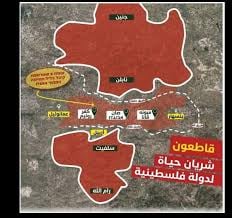

Under the protection of the occupation army, Israeli settlers are pursuing a plan to fragment the Ramallah – Al-Bireh urban area by reorganizing local roads and traffic routes, specifically through the opening of Road 463 to settler traffic. This settlement scheme aims to cut off 8 villages and 2 major neighborhoods in the northern Ramallah – Al-Bireh area from other areas to the south. The plan entails the establishment of new military outposts, checkpoints, and concrete barriers, as well as the relocation of military bases measures that would obstruct daily Palestinian movement and threaten access to vital institutions and infrastructure, such as the Istishari Hospital, the Arab American University, and facilities like the wastewater treatment plant.
Within the context, at the Surdah Junction, where road n. 463 meets the road coming from Birzeit, 6 Israelis were seen on 9 Sept. erecting a sign in Hebrew. Photos revealed that members of the family of Ita and Efraim Tzur ‘a mother and son from the Beit El settlement’, who were killed at that location in Dec. 1996’, has named the site as ‘Tzur Corridor’, however, a Palestinian security force removed the sign.
The following week, extremist settlers arriving by car from the direction of the Dolev settlement spread out along the ‘Chinese Road.’ They hung Israeli flags at 2 junctions and along the roadside, while the occupation army opened the iron gate for them, a gate situated beneath a military post that overlooks the area, in a video documenting the hanging of the flags, they wrote, ‘Here we are, returning the route to Jewish hands.’
Haaretz Newspaper reported on 28 of last September that an intensive campaign was being made to open a cross road that passes inside the Ramallah urban area to the movement of settlers, in conjunction with other steps to control lands and roads along what is known as the ‘Wallerstein Corridor’ within the framework of movements that the report said reflect the settlers’ ability to plan initiatives that may be repeated in other Palestinian areas.
According to Haaretz, opening the road to settlers would require additional security measures, such as establishing military outposts and checkpoints, and potentially seizing adjacent land, which could sever villages of Ras Karkar, Al-Janiya, Deir Ammar, Billu, Jamala, Deir Nizam, Kafr Ni’ma, and Deir Nizam, as well as 2 major neighborhoods in the northern Ramallah urban area, namely: Al-Rihan and Al-Tira neighborhoods, or the areas surrounding ‘Chinese Road’ and the Istishari Hospital north of Ramallah’ from the areas located south of the road.
The report concludes that the occupation army’s response to settler demands for shorter travel routes, coupled with the proliferation and legalization of settlement outposts and the expansion of road networks serving the settlements will deepen the fragmentation of the Palestinian landscape into smaller, increasingly isolated zones, making travel between them longer and more difficult.
For its part, the Occupation Army confirmed to the newspaper, after procrastination, that it is working to create special security conditions for future travel on the Corridor, noting at the same time that part of the road passes through Area A, which Israelis are prohibited from entering, without clarifying how to address this conflict. The road extends for about 10 km between the city of Al-Bireh and Al-Jalazoun Refugee Camp in the east and Ein Qinia in the west, and is linked to the so-called “Chinese Road” established by the Ramallah Municipality to ease jam in Ramallah and Al-Bireh.
As for ‘Olam Katan,’ the right-wing religious weekly newspaper that is the mouthpiece of ‘Rreligious Zionism,’ explained that the Israeli army is working to create conditions to open road no. 463 to settler movement, which is a road that passes through the heart of the Ramallah – Al-Bireh urban area, which may lead to the separation of neighborhoods and villages north of the urban area from the rest of its parts.
The newspaper quoted ‘Israel Gantz,’ Chairman of the Yesha Council and Chairman of the Benjamin Settlements Council ‘central West Bank’ that a preliminary decision to open the road has already been taken, and that the budget is available and the Israeli army has begun security and legal preparations to implement it.
The plan to reopen road 463 is closely linked to the outposts surrounding the ‘Talmon and Dolev settlement’ bloc, located west and northwest of Ramallah, several pastoral and agricultural outposts have been established in the vicinity of these 2 settlements, they have gradually seized vast areas of olive groves and water springs belonging to surrounding Palestinian villages.
Settlers are now demanding freedom of movement along this route and through a new outpost adjacent to the Al-Tireh Neighborhood. Intense settlement activity has recently been observed on a plot of land situated along a secondary road branching off road 463 and extending southward toward Al-Tireh. They and the army have leveled the land, installed concrete blocks and a closed gray iron gate, raised Israeli flags, and utilized the site as a gathering point for prayers.
In the southern West Bank, the Occupation Authorities are planning to establish a new settlement named ‘Ged Natan’ south of the ‘Gush Etzion settlement bloc.’ A move is part of broader settlement plans aimed at creating a contiguous belt of settlements extending toward the cities of Hebron and Jerusalem, as well as the Dead Sea. The settlement is situated on the route connecting Gush Etzion, Hebron, and the ‘Kiryat Arba settlement,’ with the objective of expanding Israeli control and bolstering the settler presence in the southern West Bank.
The Gush Etzion Regional Council and its community center have scheduled an official inauguration ceremony for the site for Tuesday, Sep. 29, 2026, the event will include guided tours for settlers led by Council Head Yaron Rosenthal. Israeli sources indicate that the Gush Etzion Regional Council has experienced a 5.1% surge in the settler population over the past year, a rate that far exceeds the general population growth average within Israel.
The occupation government recently approved the establishment of six new settlements within the Gush Etzion settlement bloc, achieved by legalizing existing outposts and converting them into independent settlements. These 6 settlements include: Masu’ot Har – formerly Masu’ot Yitzhak- established on a site designated by the Occupation Authorities as an archaeological and historical location, Givat Adullam, intended to link the Gush Etzion bloc westward toward the Elah Valley and the Beit Shemesh area, Bani Kedem, an outpost in the eastern countryside of the Bethlehem Governorate that has been officially legalized and expanded, YatzivV/Avia, located east of Beit Sahour, for which a master plan was recently approved to establish it as an independent settlement, Ya’ar HaKeren, a woodland outpost included in the government’s legalization decision to expand control over the surrounding area, and Sde Bar, an agricultural outpost near the Nokadim settlement east of Bethlehem, which was incorporated and converted into a government-recognized settlement as part of the expanded master plans for Gush Etzion.
This rapid settlement expansion within the ‘Gush Etzion bloc’ has catastrophic, direct impacts on the lives of Palestinian communities in the Bethlehem and Hebron governorates, effectively tightening the grip on Palestinian villages and towns and transforming them into isolated enclaves. The most significant of these impacts can be summarized as follows: the fragmentation of geographic continuity – isolating cities and villages – and the severing of the link between Bethlehem and Hebron.
The establishment of settlements, such as, ‘Gad Nathan and Ma’ale Arugot’ in the southern part of the bloc disrupts the natural and historic geographic connection between the cities of Bethlehem and Hebron. Moreover, it turns villages, such as Al-Walaja, Battir, Nahalin, Wadi Fukin, and Jaba’, into isolated enclaves or closed ‘cantons’ surrounded by settlements on all sides, thereby preventing their natural urban expansion.
In the southern West Bank as well, the Occupation Authorities approved granting authority to 2 settlement plans that include 567 settlement units in the Hebron Governorate, in the latest episode of acceleration witnessed in the planning and settlement expansion processes in the West Bank during the current year. The approval includes 342 settlement units in the ‘Asayel’ settlement built on the lands of the town of Al-Samou’ within plan no. 525, which the occupation cabinet approved converting into a colony in 2023, and 225 units in the ‘Beit Hagai settlement’ built on the lands of Al-Rihiyya in the Dura town within plan no. 517/4.
The Occupation Authorities has advanced the 2 plans in previous planning stages, before they were transferred in the session of the so-called ‘Planning Council’ on the 23rd of this month to the stage of granting authority, which is the stage that makes the plans effective and opens the way for completing implementation and construction procedures.
Destructive settlement activities and plans have also extended to the northern West Bank. Last week, occupation authorities issued a new tender for the construction of 400 housing units in the ‘Karnei Shomron settlement’ located east of the Qalqilia Governorate, as part of various projects aimed at expanding the existing settlement and increasing its capacity. The plan set Nov. 23, 2026, as the deadline for bid submissions, effectively marking the project’s transition from the planning and licensing phase to the marketing and construction stages.
The danger of this expansion lies in the strategic location of ‘Karnei Shomron’ in the northwestern West Bank, it encroaches upon vast tracts of land belonging to the towns of Azzun, Jinsafut, and Kafr Laqif, further fragmenting Palestinian communities in the area. The ongoing expansion of this settlement aims to merge it with neighboring settlements, such as Kedumim, Ma’ale Shomron, and Immanuel, to create a massive settlement bloc – essentially a settlement city – that links the interior of the West Bank with the area beyond the Green Line.
This project isolates Palestinian villages and towns east of Qalqilia, such as Azzun, Jinsafut, and Kafr Laqif, turning them into besieged enclaves. This stifles their natural urban expansion, geographically severs them from the cities of Qalqilia and Nablus, and reinforces total Israeli dominance along road 55, the region’s main traffic artery.
Thereby leading to the imposition of further checkpoints and restrictions on the movement of Palestinian residents, this expansion extends beyond residential construction; it entails the paving of roads, the fencing off of additional areas, and the confiscation of hundreds of dunams of fertile agricultural land and olive trees, which serve as a primary source of livelihood for the local population.
Besides, the tender for the 400 units in ‘Karnei Shomron,’ the Occupation Authorities approved a number of plans in the governorate, including a plan to confiscate the lands of Jayus and Imatin ‘Sept. 2026’ after a military decision was issued to confiscate 160 dunums of land in the town of Jayus – located behind the Apartheid Wwall – in addition to 21 dunums of land in the town of Imatin, east of the governorate.
The Occupation haS approved a package of projects that included 18 new settlement areas in the West Bank, where the Qalqilia Governorate received a large share of this through the expansion of pastoral and agricultural settlement outposts located in the east of the governorate, such as those extending between Jinsafut, Jit, and Hajjah, and transforming them into independent settlements and/or neighborhoods affiliated with major settlements.
List of Israeli Occupation and Settlers’ Assaults over the Last Week
Documented by the National Bureau:
Jerusalem:
- Storming the courtyards of the Al-Aqsa Mosque, under heavy protection from the occupation police, coinciding with the fifth day of the so-called Jewish ‘Throne Day.’ The Islamic Endowments Department in Jerusalem counted the entry of about 1,317 settlers into the mosque, where they carried out provocative tours around it. The raids witnessed the participation of Israeli political figures, including former Knesset member Moshe Feiglin, who led a group of settlers and performed Talmudic rituals inside the courtyards. The intruders also carried ‘plant offerings’ and performed public prayers in the eastern area of the mosque, in a move that reflects the escalation of attempts to impose a new reality inside the Holy Mosque. The pace of violations has reached record levels since the beginning of this year, with the total number of intruders reaching more than 52,000 settlers. Thus, the number of settlers who have stormed Al-Aqsa Mosque since the beginning of this year has risen to 52,277 settlers, amid continuing violations and an escalation in the performance of public religious rituals. These incursions were accompanied by strict military measures in the vicinity of the Old City, as the occupation forces closed several roads leading to Al-Aqsa Mosque to secure the settlers’ paths. These measures also affected the commercial sector, as shop owners in the historic Qataneen market were forced to close their shops and were prevented from carrying out their normal work in order to provide calm to them.
Hebron:
- Attacking citizens in Khirbet Safa in the Beit Ummar town, north of Hebron, and fired live bullets at them without causing any casualties.
- Demolishing facilities and destroyed agricultural lands in Khirbet Humsa, west of Hebron. The demolition operation included agricultural rooms and facilities for citizens, bulldozing areas of their land, demolishing chains, and uprooting a number of trees.
- Vandalizing property belonging to citizens Nael and Talib al-Na’amin, in the Khallet al-Hummus area in Masafer Yatta, stole a pigeon farm belonging to citizen Samir Obaid.
- Chasing workers’ vehicles amidst gunfire in Masafer Bani Naim, which resulted in one of the workers being injured, while others attacked the residence of citizen Ibrahim Ismail al-Jabour in the Huwwara area, east of Yatta, and assaulted his young son. Mustafa was beaten, causing bruises on his body.
- Storming the Ibrahimi Mosque in Hebron, the far-right Israeli Minister of National Security, Itamar Ben Gvir, led hundreds of settlers. Israeli Channel 14 broadcast scenes showing Ben Gvir, a settler in Hebron for years, storming the Ibrahimi Mosque. He said in an interview with the channel during the storming, ‘When I arrive here, I draw energy that drives me to sing and rejoice.’
Ramallah:
- Issuing a military order targeting 56,026 dunums of land in the village of Kafr Malek, bearing the number 98/26, to remove wild plants and uproot olive trees from them under the pretext of taking ‘security measures.’ The targeted lands are located along road no. 449 south of the village. The military order obliges the landowners to carry out the removal within 7 days of a tour organized with them.
- Stealing olive fruits from a number of citizens’ lands located along the lands between the towns of Sinjil and Turmusaya, opposite the entrance to the town of Turmusaya, near an occupation forces camp.
- Attacking an ambulance vehicle and stole agricultural equipment in the village of Al Mughair, which led to material damage to it. They also stole agricultural equipment during their raid on a sheep farm west of the village. In another attack in the village of Al Mughair, settlers burned 2 vehicles belonging to the citizens Jihad Al Naasan and Musa Moh’d Abu Alia, and his tent and wrote racist slogans on his children’s houses.
- Uprooting scores of olive trees and bulldozed forest lands and trees in the village of Beit Ur al-Fawqa. They also distributed a notice to bulldoze 29 dunams of citizens’ lands planted with trees.
- Burning 3 vehicles in the village of Rantis, before the residents confronted them and forced them to leave, which led to partial damage to the vehicles. Racist slogans on the walls of a number of citizens’ houses.
- Storming agricultural land and released their livestock among the olive trees in the village of Barqa, causing damage to the olive trees.
- Bulldozing large areas of land and uprooted hundreds of olive trees in the town of Beit Rima, after a decision was issued to remove perennial olive trees on an area of 31 dunams from the town’s land.
- Storming the Griot Junction in the Beitunia town in the middle of the town, to establish Talmudic rituals, coinciding with the celebration of Jewish holidays.
Nablus:
- Attacking a group of young men and seized their vehicle in the ‘Al-Arma’ area in Beita, south of Nablus, while dozens of settlers burned 2 houses belonging to the Al-Toubasi family in the village of Jalud, south of Nablus, after the family was trying to return to them during the implementation of an occupation court decision to return them to the two houses from which they were taken, after the settlers seized them last July. The settlers also burned a family vehicle, and tried to burn a school, but the people confronted them and prevented them from doing so.
- Attacking a number of citizens’ homes with stones on the outskirts of the village of Qaryut, south of Nablus, where the settlers assaulted an elderly woman and tried to burn her house.
Salfeet:
- Preventing farmers from the Derastia town from reaching their lands to pick olives, in the Al-Maareed area, west of the town.
- Storming the town of Qarawat Bani Hassan’s playground and forced the young men in it to leave it at gunpoint.
- Storming the Kafl Haris town under heavy protection from the occupation forces, and raided Islamic religious shrines in the center of the town, performed Talmudic rituals, and deliberately vandalized all citizens’ property.
Jenin:
- Stealing olives from the lands of Khirbet Masoud, south of Jenin.
- Organizing a major settlement march last Wednesday between the ‘Ganim and Kadim settlements,’ within the framework of ‘Sukkot Day activities,’ with the participation of large numbers of settlers. The organizing authorities said that the march bears the name ‘Samaria and starts from Ganim towards Kadim, in an event that seeks to shed light on the re-establishment of the two settlements in the northern West Bank.”